Valparaiso, Chile UFO Sighting (March 4, 1953) — FBI Files
An FBI-documented report from 1953 details an unidentified object sighting in Valparaiso, Chile, forwarded by J. Edgar Hoover to the Air Force.
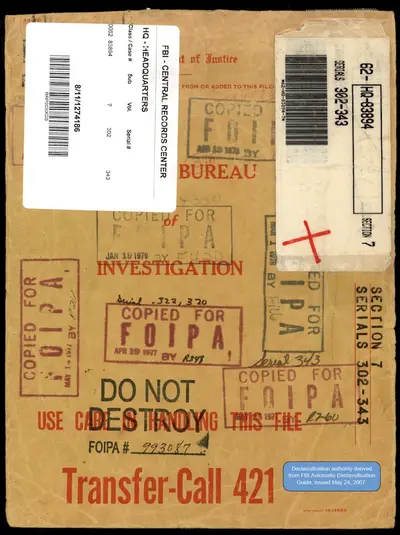
Background
On March 4, 1953, in Valparaiso, Chile, U.S. government investigators recorded an unidentified-object incident that remained shielded from public view for decades. The details of this encounter were eventually released to the public on May 8, 2026, as part of the Presidential Unsealing and Reporting System for UAP Encounters (PURSUE). This case emerged during the height of the Cold War, a period characterized by intense global surveillance and heightened sensitivity regarding airspace integrity. The investigation of such phenomena during this era fell under the purview of the United States Air Force’s various research programs, most notably Project Blue Book or its preceding investigative frameworks.
During the early 1950s, the presence of unidentified aerial phenomena was viewed through a lens of national security. The United States government maintained rigorous protocols for monitoring any objects that could potentially represent technological advancements by adversarial nations. Because of the strategic importance of various global installations, the Federal Bureau of Investigation (FBI) maintained a standardized procedure for handling reports of unidentified objects. Field offices in cities such as Knoxville, Albuquerque, and Los and Angeles were tasked with routing UFO reports to FBI headquarters. This centralized processing ensured that any sighting that might impact the protection of vital installations or involve sensitive intelligence was scrutinized by federal authorities.
The Documented Incident
The primary evidence regarding this specific event consists of a letter from a Mrs. Silva detailing her observations. This communication was received by FBI Director J. Edgar Hoover. While the released document does not provide a detailed description of the physical characteristics, flight path, or behavior of the object observed by Mrs. Silva, the nature of the correspondence prompted official action. The content of her observations was deemed sufficiently significant to be considered potentially interesting to another governmental agency. Consequently, Hoover forwarded a copy of her communication to the Secretary of the Air Force for further review.
The released documentation does not specify the total number of witnesses present during the sighting in Valparaiso. The report focuses on the administrative handling of the civilian testimony rather than the empirical data of the sighting itself. This pattern of documentation is common in mid-century intelligence files, where the emphasis often rested on the official chain of custody and the referral of information between departments rather than the scientific analysis of the phenomenon.
Classification and Analytical Context
The case is classified as a visual sighting reported by ground or air observers. Such reports were the cornerstone of mid-century aerial anomaly research, providing the raw data used to populate the databases of the Air Force and the FBI. In the context of 1953, such sightings were often analyzed against a backdrop of rapid advancements in aerospace technology.
All records released under the PURSUE program are designated as unresolved by the All-domain Anomaly Resolution Office (AARO) by default. The federal government has not reached a definitive conclusion regarding whether the events in Valparaiso were anomalous or conventional, and it has not ruled out either possibility. In the historical context of the 1950s, researchers frequently considered several conventional candidates for such sightings. These included experimental aircraft testing, the presence of weather balloons—specifically those associated with the Project Mogul series active in the late 1940s—and various atmospheric optical phenomena such as sundogs or lenticular clouds. Additionally, astronomical objects like Venus, the Moon, or meteors appearing near the horizon were frequently cited as plausible explanations for unidentified lights in the night sky.