Franklin, Indiana UFO Sighting (January 20, 1953) — FBI Files
An FBI file documents a 1953 report from Robert De Wolf regarding an unidentified object observed over Franklin, Indiana.
Historical Context
The early 1950s represented a period of heightened atmospheric and geopolitical tension in the United States. Following the onset of the Cold War, the American public and government agencies remained hyper-vigilant regarding unauthorized aerial incursions. This era was characterized by the rapid advancement of aerospace technology and the proliferation of high-altitude reconnaissance programs. During this time, the United States Air Force maintained various investigative projects, most notably Project Blue Book, to analyze reports of Unidentified Flying Objects (UFOs). These investigations sought to determine whether such sightings represented Soviet technological breakthroughs, secret domestic experimental aircraft, or natural atmospheric phenomena.
The geographic region of Franklin, Indiana, sits within the American Midwest, an area that, during the mid-twentieth century, was part of a broader pattern of sightings across the continental United States. The presence of various military installations and the increasing density of civilian aviation made the Midwest a frequent subject of aerial observation reports. At the time, the classification of such sightings often fell under the purview of multiple federal agencies, as the potential for these objects to interfere with the security of vital installations or national airspace necessitated a coordinated, albeit fragmented, response.
The 1953 Incident
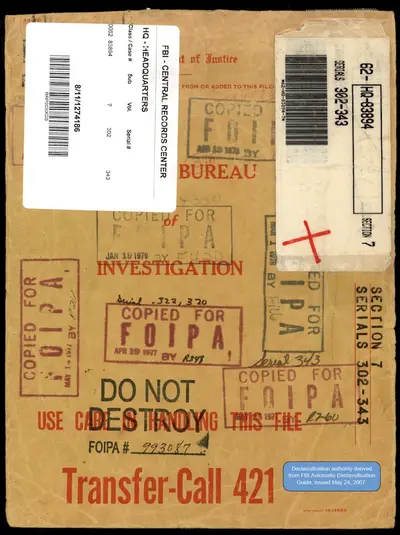
On January 20, 1953, an unidentified-object incident occurred in Franklin, Indiana. The details of this event were documented within United States government records and were later released to the public on May 8, 2026, as part of the Presidential Unsealing and Reporting System for UAP Encounters (PURSUE). The documentation reveals that Robert De Wolf initiated contact with the Federal Bureau of Investigation (FBI) to report his observations. De Wolf submitted a formal letter to the Bureau, which included various enclosures, though the specific nature or content of these enclosures was not detailed in the released file.
The FBI’s handling of the report followed established administrative protocols of the era. The Bureau’s various field offices, including those in Knoxville, Albuquerque, and Los Angeles, were tasked with routing UFO reports to headquarters to ensure the protection of sensitive installations. While the FBI acknowledged the receipt of De Wolf’s correspondence, the agency explicitly stated in its records that it was not conducting a formal investigation into the matter. Because the specific descriptions provided by De Wolf were not transcribed in the released document, the precise visual characteristics of the object remain unknown. Furthermore, the released documentation does not specify the number of witnesses present during the sighting.
Classification and Analysis
The Franklin case is categorized as a visual sighting reported by ground or air observers. In the broader context of mid-century aerial phenomena, such reports were often analyzed against a set of conventional candidates. During the late 1940s and early 1950s, the presence of Project Mogul—a high-altitude balloon program designed to detect Soviet nuclear tests—frequently led to misidentifications of weather balloons as anomalous objects. Other common explanations for sightings of this period included experimental aircraft, astronomical bodies such as Venus or the Moon positioned near the horizon, meteors, and atmospheric optical phenomena like lenticular clouds or sundogs.
Under the current oversight of the All-domain Anomaly Resolution Office (AARO), all records released through the PURSUE program are designated as unresolved by default. The federal government has maintained a position of neutrality regarding the Franklin sighting, neither concluding that the event was anomalous nor confirming that it was caused by conventional means. The case remains an unverified entry in the archive of documented aerial phenomena, representing a period of intense scrutiny regarding the contents of the American sky.