Nashville, Tennessee UFO Sighting (March 13, 1952) — FBI Files
On March 13, 1952, an unidentified blue object with a red fringe was observed moving across the Nashville sky, as documented in released FBI files.
Historical Context
The early 1950s represented a period of heightened tension and atmospheric uncertainty within the United States. Following the 1947 Kenneth Arnold sighting and the subsequent Roswell incident, the American public and various government agencies entered an era of intense scrutiny regarding unidentified aerial phenomena. This period saw a surge in “flying saucer” reports, driven by the burgeoning Cold War and the technological advancements in aerospace engineering. During this era, the phenomenon of Unidentified Flying Objects was often viewed through the lens of national security, as the possibility of advanced Soviet technology or extraterrestrial presence loomed over the domestic landscape.
The administrative handling of such reports was highly standardized during this decade. The Federal Bureau of Investigation maintained a systematic approach to documenting aerial anomalies, particularly when they occurred near sensitive locations. Field offices in cities such as Knoxville, Albuquerque, and Los Angeles operated under standing protocols designed to protect vital installations. When an unusual aerial event was reported, these regional offices were tasked with routing the information to FBI headquarters. This bureaucratic process ensured that any potential threat to national infrastructure was centralized for assessment, treating unidentified objects as matters of potential intelligence significance.
The Nashville Incident
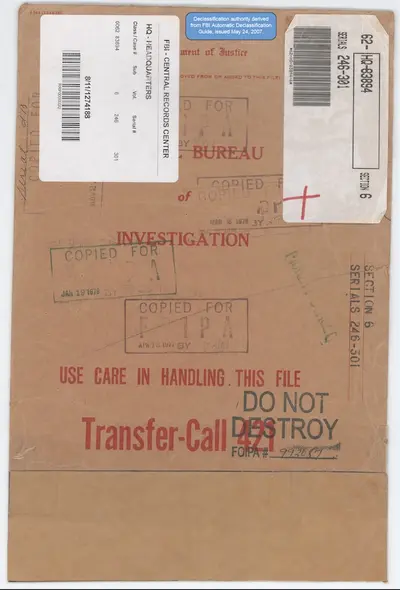
On March 13, 1952, an unidentified-object incident occurred in Nashville, Tennessee. The details of this event remained largely shielded from the public for decades, only becoming accessible via the Presidential Unsealing and Reporting System for UAP Encounters (PURSUE) on May 8, 2026. The documentation provides a specific account of the observation, which was recorded by Lieutenant Kuhn.
While observing the moon, Lieutenant Kuhn noted the presence of a circular, bright blue object. The object was characterized by a distinct reddish fringe along its perimeter. The trajectory of the object was recorded as moving from the northwest toward the southeast. The duration of the sighting was brief, with the object disappearing after approximately three seconds. In his initial assessment, Lieutenant Kuhn considered whether the object could have been a high-powered spotlight; however, he ultimately dismissed this hypothesis due to the clear sky conditions present at the time of the sighting. While the released documents confirm the observation, the total number of witnesses involved in the event is not specified in the official record.
Analysis and Classification
The Nashville case is classified as a visual sighting reported by ground or air observers. In the broader study of mid-century aerial phenomena, such sightings are often compared to other high-altitude observations of the same era, which frequently involved rapid movement and distinct colorations. The movement of the object across the sky in a matter of seconds is a common characteristic in many documented cases from the 1950s, often leading to debates regarding the physical capabilities of the observed craft.
The status of the Nashville incident remains officially unresolved. Under the current guidelines of the All-domain Anomaly Resolution Office (AARO), all records released through the PURSUE program are designated as unresolved by default. The federal government has maintained a position of neutrality regarding the nature of the object, neither concluding that the event was anomalous nor confirming that it was the result of conventional means.
When evaluating sightings from this period, investigators typically consider several conventional candidates. These include experimental aircraft testing, which was prevalent during the early Cold War, and weather balloons, specifically those associated with the Project Mogul series. Other possibilities include atmospheric optical phenomena, such as lenticular clouds or sundogs, as well as the presence of known astronomical objects like Venus, meteors, or the moon near the horizon. The Nashville sighting remains a documented part of the archival record, representing the era’s complex intersection of civilian observation and federal intelligence monitoring.