Oak Ridge, Tennessee UFO Sighting (December 18, 1950) — FBI Files
On December 18, 1950, witnesses near Oak Ridge, Tennessee, reported a bright, circular light traveling across the night sky, documented in FBI files.
Historical Context
The sighting in Oak Ridge, Tennessee, occurred during a period of intense national preoccupation with unidentified aerial phenomena. Following the June 1947 Kenneth Arnold sighting and the July 1947 Roswell incident, the United States experienced a wave of “flying saucer” reports that permeated both popular culture and military intelligence. During this era, the Cold War was entering a critical phase, and the presence of unidentified objects in the sky was viewed through a lens of national security. The geographic location of this specific event, Oak Ridge, added significant weight to the investigation. As a key site for the Manhattan Project and a vital center for nuclear research, the area was under heavy surveillance and subject to strict protocols regarding the protection of sensitive government installations.
During the early 1950s, the Federal Bureau of Investigation (FBI) maintained a structured approach to managing reports of unidentified objects. Under the Bureau’s standing protocols for the protection of vital installations, field offices in cities such as Knoxville, Albuquerque, and Los Angeles were tasked with routing UFO reports to headquarters. This ensured that any potential threat to high-security sites, such as the nuclear facilities in Oak Ridge, was centralized and analyzed by federal investigators. The administrative handling of this case reflects the era’s transition from viewing such sightings as mere curiosities to treating them as potential intelligence or security concerns.
The Incident
On December 18, 1950, multiple witnesses observed a bright, circular light while traveling on the Turnpike near Oak Ridge, Tennessee. The light was noted for being significantly brighter than the moon and appeared to possess a distinct form. It was observed traveling in a northwesterly direction at an elevation between 15 and 30 degrees. Some observers interpreted the phenomenon as a reflection of the sun off a metallic surface, though the exact size and range of the object remained difficult to estimate.
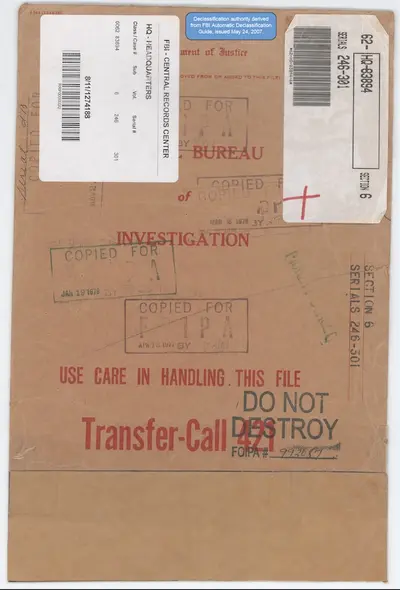
The official documentation, which was released to the public on May 8, 2026, as part of the Presidential Unsealing and Reporting System for UAP Encounters (PURSUE), provides specific technical observations. The file records that the light gave the impression of form in connection with the light and was white in appearance. Notably, the light did not show any signs of refraction into a band or continuous spectrum. The documentation also notes that the object appeared to diminish considerably in size during thirty seconds of observation. While the document records these specific visual details, the total number of witnesses involved in the sighting is not specified in the released text.
Investigation and Classification
The case is classified as a visual sighting reported by ground or air observers. In the decades following the event, the nature of the sighting remained a matter of federal record rather than settled fact. Under the current framework of the All-domain Anomaly Resolution Office (AARO), all records released under the PURSUE program are designated as unresolved by default. The federal government has maintained a neutral stance, neither concluding that the event was anomalous nor confirming that it was caused by conventional means.
In the context of 1950s aerial phenomena, several conventional candidates are often considered by researchers. These include experimental aircraft being tested in the post-war era, weather balloons—specifically those associated with the Project Mogul series active in the late 1940s—and various atmospheric optical phenomena such as lenticular clouds or sundogs. Additionally, astronomical objects like Venus, the Moon, or meteors near the horizon are frequently cited as potential explanations for bright, moving lights. The Oak Ridge file remains part of the ongoing archival effort to categorize these historical sightings within the broader scope of documented aerial anomalies.