Oak Ridge, Tennessee UFO Sighting (February 18, 1949) — FBI Files
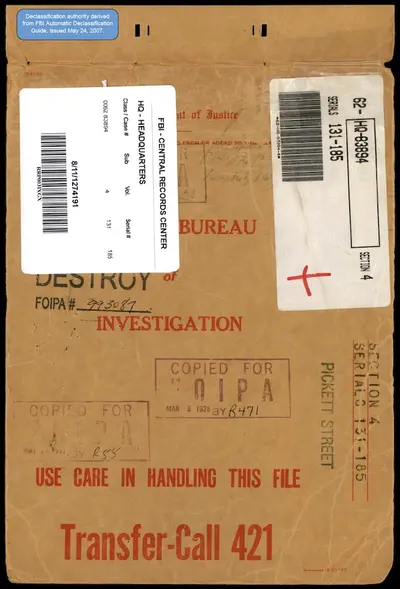
FBI records detail a 1949 investigation into alleged flying saucer photographs in Oak Ridge, Tennessee, examined by Air Force Colonel Gasser.
Background
On February 18, 1949, in Oak Ridge, Tennessee, U.S. government investigators recorded an unidentified-object incident later released to the public on May 8, 2026, as part of the Presidential Unsealing and Reporting System for UAP Encounters (PURSUE). This sighting occurred during a period of intense national preoccupation with aerial anomalies. The incident is part of the first wave of “flying saucer” reports that swept the United States following the Kenneth Arnold sighting of June 1947 and the Roswell incident of July 1947. During this era, the sudden appearance of unidentified aerial phenomena prompted widespread speculation regarding advanced technology, ranging from secret Soviet developments to extraterrestrial visitors.
The geographic location of the event, Oak Ridge, provided a unique context for such reports. As a high-security site central to the Manhattan Project and the subsequent development of nuclear technologies, the area was under constant surveillance and subject to strict federal oversight. Because of the sensitivity of the installations in Tennessee, the Federal Bureau of Investigation maintained rigorous monitoring protocols. The case was filed with the FBI, whose Knoxville, Albuquerque, Loskan, and other field offices routed UFO reports to headquarters under the Bureau’s standing protocols for the protection of vital installations. This administrative structure ensured that any potential aerial intrusion near nuclear facilities was treated as a matter of national security.
Investigation and Findings
The released documentation focuses heavily on the investigation of photographic evidence associated with the event. Photographs of alleged flying saucers were investigated by Colonel Gasser of the Air Force. Upon examination, Gasser determined the photographs were likely the result of an accident or hoax, and not genuine images of unidentified objects. Despite this conclusion, Gasser maintained his belief in the existence of flying saucers and the validity of his previous statements regarding the phenomenon. This tension between specific photographic evidence and a broader belief in the reality of unidentified objects was a common theme in mid-century aerial investigations.
While the visual nature of the event is well-documented, the number of witnesses is not specified in the released document. The investigation primarily centered on the physical evidence of the images rather than a tally of observers. This focus on photographic analysis was characteristic of the era’s investigative methods, where the difficulty of obtaining reliable eyewitness testimony often led investigators to rely on the more tangible, albeit often ambiguous, photographic record.
Classification and Analysis
The case is classified as a visual sighting reported by ground or air observers. In the broader context of Unidentified Aerial Phenomena (UAP) research, this incident belongs to the category of sightings involving perceived structural shapes, often described as discs or saucers.
All records released under the PURSUE program are designated unresolved by the All-domain Anomaly Resolution Office (AARO) by default. The federal government has not concluded that the events were anomalous, has not concluded that they were conventional, and has not ruled out either possibility. The ambiguity of the status reflects the ongoing difficulty in verifying historical reports without contemporary sensor data.
Conventional candidates for sightings of this period include experimental aircraft, weather balloons, particularly the Project Mogul series in the late 1940s, and atmospheric optical phenomena such as sundogs and lenticular clouds. Additionally, astronomical objects including Venus, the Moon, and meteors near the horizon frequently provided explanations for sightings of bright, moving lights. The Oak Ridge incident remains a significant entry in the archival study of how the intersection of high-security geography and mid-century technological anxiety shaped the reporting of aerial anomalies.