Killeen Base, Camp Hood UFO Sighting (March 6, 1949) — FBI Files
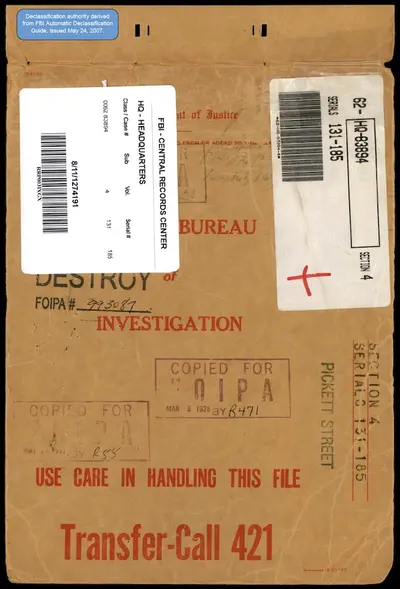
FBI records document two flare-like unidentified objects observed near Camp Hood, Texas, in March 1949, during the height of the post-war flying saucer era.
Historical Context
The sighting at Killeen Base occurred during a period of intense national fascination and anxiety regarding unidentified aerial phenomena. Following the June 1947 Kenneth Arnold sighting and the July 1947 Roswell incident, the United States experienced a significant surge in reports of “flying saucers.” This era was characterized by a lack of established scientific frameworks for interpreting such sightings, leading much of the public and various government agencies to struggle with distinguishing between atmospheric anomalies, secret military technology, and potentially extraterrestrial craft.
During the late 1940s, the geographic landscape of the American Southwest and South was increasingly occupied by sensitive military installations. As the Cold War intensified, the security of these bases became a primary concern for federal law enforcement. The Federal Bureau of Investigation (FBI) maintained specific protocols for handling reports that could potentially impact the safety of vital installations. Under these standing protocols, field offices in cities such as Knoxville, Albuquerque, and Los Angeles were tasked with routing UFO reports to headquarters to ensure that any threat to military infrastructure was properly vetted and documented.
The Incident
On March 6, 1949, investigators recorded an unidentified-object incident at Killeen Base, located within Camp Hood, Texas. The documentation for this event was later released to the public on May 8, 2026, as part of the Presidential Unsealing and Reporting System for UAP Encounters (PURSUE). The specific details of the observation indicate that at approximately 7:30 p.m. on March 6, a flare-like object was observed roughly half a mile north of Killeen Base.
The activity continued into the early hours of the following day. At approximately 1:45 a.m. on March 7, 1949, a second flare was sighted approximately three miles from the base. While the released FBI documents do not specify the exact number of witnesses involved in these observations, the official record notes that these flares were considered similar to phenomena previously observed at other high-security locations, specifically Los Alamos and Sandia Base. This comparison suggests that the nature of the light signatures was consistent with other reported anomalies occurring at sensitive nuclear and military research sites during the same period.
Analysis and Classification
The case is classified as a visual sighting reported by ground or air observers. Because the documentation lacks specific identification of the objects, the event remains categorized as an unidentified aerial phenomenon. In the context of 1949, such reports were often scrutinized against known technological developments. The presence of similar sightings at Los Alamos and Sandia Base highlights a pattern of observed anomalies near high-priority military and scientific research hubs.
The status of the Killeton Base sighting remains officially unresolved. All records released under the PURSUE program are designated as unresolved by the All-domain Anomaly Resolution Office (AARO) by default. The federal government has maintained a neutral stance, neither concluding that the events were anomalous nor confirming that they were the result of conventional means.
When evaluating sightings from this era, researchers often consider several conventional candidates. These include the deployment of experimental aircraft or the presence of weather balloons, particularly those associated with the Project Mogul series, which utilized high-altitude balloons to detect Soviet nuclear tests. Other possibilities include atmospheric optical phenomena, such as lenticular clouds or sundogs, and the presence of bright astronomical objects like Venus, the Moon, or meteors appearing near the horizon. The Killeen Base incident remains part of the broader historical record of unverified aerial phenomena during the early Cold War.