Jackson, Mississippi UFO Sighting (January 1, 1949) — USAF Files (D25P132)
On New Year's Day 1949, a pilot and his wife observed an unidentified object near Jackson, Mississippi, as documented in released USAF records.
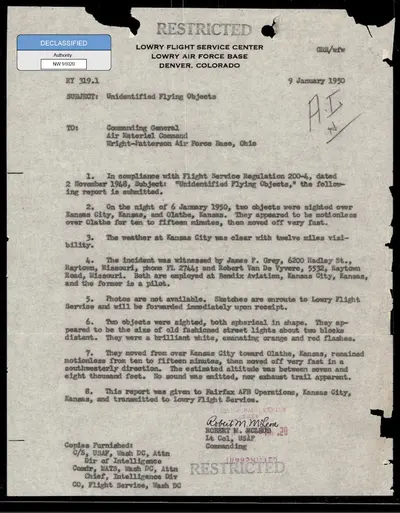
Historical Context
The sighting in Jackson, Mississippi, occurred during a transformative period in the study of unidentified aerial phenomena. The late 1940s are widely recognized by historians of the phenomenon as the era of the first wave of “flying saucer” reports. This period was characterized by a sudden surge in public and military interest following the June 1947 Kenneth Arnold sighting and the subsequent July 1947 Roswell incident. During this time, the American public was grappling with the implications of new technologies emerging from the Second World War, and the concept of extraterrestrial visitation became a staple of contemporary discourse.
The geopolitical climate of 1949 played a significant role in how such sightings were processed by the United States government. As the Cold War intensified, the presence of unidentified objects in domestic airspace became a matter of national security. The United States Air Force (USAF) and other intelligence agencies were tasked with determining whether these objects represented advanced Soviet technology or something entirely outside the realm of known physics. Consequently, reports like the one from Jackson were meticulously logged within Department of Defense documentation, often as part of broader efforts to monitor atmospheric anomalies.
The Incident
On January 1, 1949, at approximately 1700 hours, an unidentified object was observed in the vicinity of Jackson, Mississippi. The primary witnesses to the event were a pilot and his wife. According to the official records, the object was positioned approximately two miles off the coast of Jackson. While the geographical description of the object being “off the coast” of an inland Mississippi city may seem anomalous to modern readers, the documentation remains a fixed part of the historical record.
The meteorological conditions during the sighting were documented with specific detail. At the time of the observation, the sky featured broken clouds at an estimated altitude of 16,000 feet. Visibility was reported to be approximately 15 miles, providing a relatively clear environment for visual identification. The witnesses provided their occupations and residential addresses to investigators, and the documentation notes that a photograph of the object was reportedly available at the time of the report. While the specific number of witnesses is not explicitly stated in the released document, the primary account rests with the aforementioned pilot and his spouse.
Documentation and Analysis
The details of this case were made available to the public on May 8, 2026, through the Presidential Unsealing and Reporting System for UAP Encounters (PURSUE). This release is part of a broader movement toward transparency regarding historical unidentified aerial phenomena. The case is officially cataloged under USAF File D25P132 and is classified as a type of case involving photographic evidence.
As with all records released under the PURSUE program, the All-domain Anomaly Resolution Office (AARO) has designated this case as unresolved by default. The federal government has maintained a neutral stance, neither concluding that the object was anomalous nor confirming that it was a conventional phenomenon. In the context of 1949, investigators often considered several conventional candidates for such sightings. These included experimental high-altitude aircraft, weather balloons—specifically those associated with the Project Mogul series designed to detect Soviet nuclear tests—and various atmospheric optical phenomena such as lenticular clouds or sundogs. Additionally, astronomical bodies like Venus, the Moon, or meteors positioned near the horizon were frequently evaluated as potential explanations for unidentified lights in the night sky.