Sear Turner AF Base UAP Encounter, 1948 — USAAF Box 7 #188
An unidentified object was reported near Sear Turner AF Base in 1948 by a co-pilot, as documented in declassified U.S. Army Air Forces records.
Historical Context
The year 1948 represented a period of significant atmospheric and geopolitical tension in the United States. Following the conclusion of World War II, the newly established United States Army Air Forces (USAAF) was navigating the transition into the jet age while simultaneously managing an influx of reports regarding unidentified aerial phenomena. This specific era is characterized by the “first wave” of sightings, a phenomenon triggered by the June 1947 Kenneth Arnold sighting and the subsequent July 1947 Roswell incident. During this time, the term “flying saucer” entered the popular lexicon, and military installations across the country became frequent sites for observations of objects that defied contemporary aerodynamic understanding.
The geography of the American South, particularly regions surrounding military installations in Georgia, provided a backdrop of high-frequency aerial activity. Air bases like Sear Turner AF Base in Albany, Georgia, were central to the nation’s defense infrastructure, hosting various training and reconnaissance missions. The presence of organized aircrews meant that there was a constant, trained population of observers capable of noting deviations in the sky. At the time, the military lacked a centralized, modern framework for investigating these anomalies, often relying on standardized check-lists and manual reporting systems to catalog unusual sightings for intelligence purposes.
The Incident Records
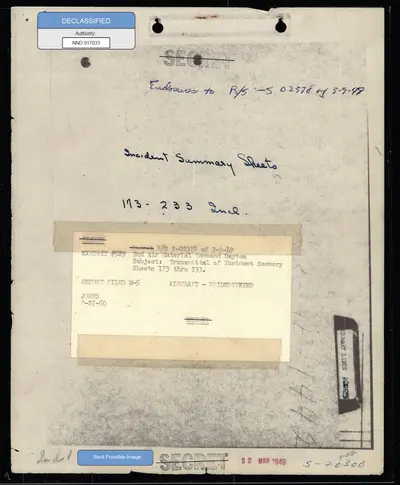
The documentation for Incident #188 is contained within the “Check-List - Unidentified Flying Objects” series, specifically archived in Box 7 of file 38_143685. These records remained largely inaccessible to the public for decades until their release by the Department of War on May 8, 2026. This disclosure was part of the Presidential Unsealing and Reporting System for UAP Encounters (PURSUE), a large-scale declassification effort intended to provide transparency regarding historical aerial anomalies.
The specific summary within the form records an unidentified-object incident occurring near Sear Turner AF Base in Albany, Georgia. The report identifies the observer as acting in the capacity of a co-pilot, specifically noted as Ma-tin G, Rubicon. The nature of the sighting is categorized as a pilot or aircrew sighting, meaning the observation was made directly from a cockpit during active flight operations. While the specific flight path and the precise visual characteristics of the object are not detailed in the summary, the entry serves as a formal military acknowledgment of an encounter that deviated from standard aerial traffic.
Analysis and Classification
The classification of this event as a UAP (Unidentified Anomalous Phenomenon) follows the modern nomenclature used by the All-domain Anomaly Resolution Office. Under the PURSUE program, all released records of this nature are officially designated as unresolved. The federal government has maintained a strictly neutral stance regarding the origin of the object in Incident #188, neither confirming the presence of anomalous technology nor attributing the sighting to known conventional craft.
In the broader context of 1948 aerial reports, researchers often look to several conventional candidates to explain such sightings. During this period, the United States was conducting Project Mogul balloon flights, which utilized high-altitude sensors to detect Soviet nuclear tests; these balloons were often misidentified as unidentified objects. Additionally, the rapid development of experimental jet and rocket aircraft, alongside various atmospheric optical effects and the misidentification of astronomical bodies, provided a spectrum of plausible, non-anomalous explanations. However, without further corroborating data from the 1948 flight logs, the encounter at Sear Turner AF Base remains an unverified component of the post-war saucer wave.