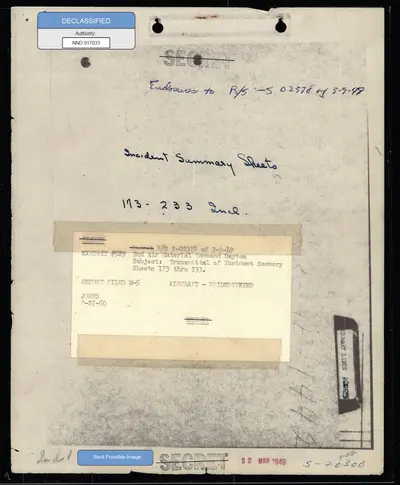
New Brighton, Pa UAP Encounter, 1948 — USAAF Box 7 #230
Documentation from the U.S. Army Air Forces archives details a 1948 unidentified object sighting near New Brighton, Pennsylvania.
Historical Context
The year 1948 represented a period of intense transition for American airspace and national security. Following the conclusion of World War II, the United States was navigating the early stages of the Cold War, a period characterized by rapid advancements in aeronautical engineering and an increasing preoccupation with aerial surveillance. The emergence of the “flying saucer” phenomenon in the public consciousness was largely precipitated by the June 1947 Kenneth Arnold sighting and the subsequent July 1947 Roswell incident. These events triggered a widespread wave of reports across the continental United States, as both civilian populations and military personnel began documenting aerial anomalies that defied contemporary aerodynamic explanations.
During this era, the scientific and military communities struggled to categorize these sightings. The technological landscape was shifting from propeller-driven aircraft to the dawn of the jet age, creating a vacuum of understanding regarding high-altitude, high-velocity objects. While some researchers looked toward atmospheric phenomena or secret Soviet developments, others focused on the possibility of unrecognized domestic experimental technology. This ambiguity defined the late 1940s, as the distinction between conventional aerospace development and truly anomalous phenomena remained blurred in official documentation.
The New Brighton Incident
In 1948, near New Brighton, Pennsylvania, the U.S. Army Air Forces recorded an unidentified-object incident that became Incident #230 in the “Check-List - Unidentified Flying Objects” series archived in Box 7 of file 38_143685. The specific details of this encounter were preserved within military logs and were eventually released by the Department of War on May 8, 2026, as part of the Presidential Unsealing and Reporting System for UAP Encounters (PURSUE). The documentation identifies the event as a visual sighting reported by observers positioned at the ground, air, or control tower.
The official summary records for Incident #230 provide specific data points regarding the nature of the encounter, including the occupation and hobbies of the observers, the manner in which attention was attracted to the object, the number of objects seen, and the perceived size and odor of the objects. Despite the technical nature of these logs, the specific descriptive details of the New Brighton sighting remain part of a larger, fragmented archive of mid-century aerial observations. The presence of this case within the Army Air Forces’ specialized checklist indicates that the military was actively tracking and categorizing these sightings as they occurred, even if the underlying cause of the objects remained unknown.
Classification and Investigation
The New Brighton case is classified as a visual sighting reported by ground or air observers. This type of reporting was common during the 1947-1948 saucer wave, as the visibility of the objects allowed for direct ocular observation by both military personnel and civilian bystanders. Such reports were often scrutinized for their reliability, as the era was marked by a high volume of both genuine anomalies and misidentified conventional objects.
The status of the New Brighton encounter remains officially unresolved. Under the protocols of the All-domain Anomaly Resolution Office, all records released under the PURSUE program are designated as unresolved. The federal government has maintained a neutral stance regarding the 1947-era incidents, neither concluding that these sightings were anomalous nor confirming them as conventional. The possibility of both remains open in the official record.
When analyzing the 1947-era saucer wave, historians and researchers often consider several conventional candidates that could explain such sightings. These include the Project Mogul balloon flights, which were active over the U.S. Southwest at the time, as well as experimental jet and rocket aircraft undergoing testing. Other possibilities include atmospheric optical effects or astronomical objects that were misidentified due to unusual viewing angles. The New Brighton incident persists as a documented piece of this complex historical puzzle, representing the ongoing difficulty in distinguishing between the known and the unknown in post-war aviation history.