Fairfield-Suisun AF Base UAP Encounter, 1948 — USAAF Box 7 #211
Documentation from 1948 details a visual sighting of an unidentified object near the Fairfield-Suisun Air Force Base control tower, observed via Spower…
Historical Context
The year 1948 represented a period of significant transition for American aerospace surveillance and military intelligence. Following the conclusion of the Second World War, the United States Army Air Forces (USAAF) found itself navigating an era of rapid technological advancement and increasing atmospheric uncertainty. This period was characterized by the emergence of the “flying saucer” phenomenon, a wave of mass sightings that began in the summer of 1947. The cultural and military landscape was heavily influenced by the Kenneth Arnold sighting in June 1947 and the subsequent Roswell incident in July 1947, both of which fundamentally altered the public and military perception of unidentified aerial phenomena. During this time, the distinction between experimental high-altitude reconnaissance, such as the Project Mogul balloon flights, and truly anomalous objects remained difficult to establish through standard visual observation.
The geographical area surrounding Fairfield-Suisun Air Force Base in California served as a critical node for military aviation operations. As a strategic installation, the base was subject to rigorous monitoring by personnel tasked with maintaining airspace integrity. The presence of control tower staff and observers equipped with high-powered optics, such as Spower binoculars, provided a consistent layer of ground-based surveillance. This infrastructure was essential for tracking both conventional military sorties and the increasing number of unidentified reports that were being logged into official military archives.
Incident Details and Documentation
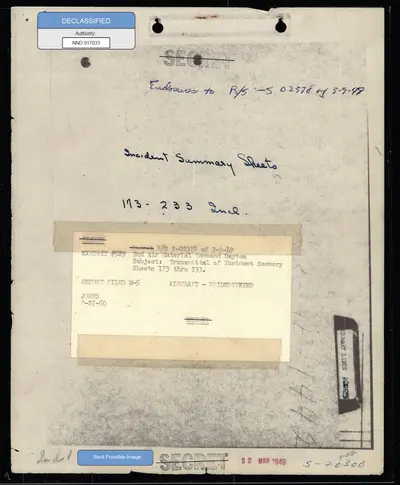
Incident #211 of the U.S. Army Air Forces “Check-List - Unidentified Flying Objects” series provides a specific account of an unidentified object sighted near the Fairfield-Suisun Air Force Base. According to the official summary, the sighting occurred north of the field control tower and was observed through the use of Spower binoculars. The documentation identifies the observers as control tower personnel, indicating that the sighting was captured by trained military staff during active duty.
The primary source for this event is found in the archives of Box 7, file 38_143685, which contains a series of systematic logs maintained by the USAAF. These records were officially released to the public by the Department of War on May 8, 2026, under the auspices of the Presidential Unsealing and Reporting System for UAP Encounters (PURSUE). The form itself records the nature of the attention attracted by the object and the specific location of the sighting relative to the base’s control tower, categorizing the event as a visual sighting reported by ground-based observers.
Analytical Classification and Status
The classification of this case is defined as a visual sighting, a type of report where the phenomenon is identified through direct optical observation by ground or air-based personnel. In the context of 1948, such reports were often difficult to verify due to the lack of advanced radar technology and the limitations of mid-century photographic equipment. The reliance on binoculars and human eyesight meant that many sightings were subject to the complexities of atmospheric conditions and the potential for misidentification of known aerial objects.
As of the current archival status, all records released through the PURSUE program are designated as unresolved by the All-domain Anomaly Resolution Office. The federal government has maintained a neutral stance regarding the nature of these 1947-era incidents. There has been no formal conclusion stating that the Fairfield-Suisun sighting was anomalous, nor has there been a definitive determination that it was caused by conventional means. Potential conventional explanations for such sightings during this era include the presence of experimental jet and rocket aircraft, atmospheric optical effects, astronomical objects viewed at unusual angles, or the classified Project Mogul balloon flights that were active over the American Southwest at the time. The case remains an open entry within the official historical record of unidentified aerial phenomena.