Edmonton, Alberta Canada UFO Sighting (November 17, 1948) — USAF Files
U.S. government records detail an orange, egg-shaped object observed over Edmonton, Alberta, on November 17, 194
Historical Context
The sighting in Edmonton, Alberta, occurred during a period of significant atmospheric and geopolitical transition. In the late 1940s, the North American continent was experiencing a surge in reported unidentified aerial phenomena, often categorized under the then-emerging “flying saucer” nomenclature. This era of reporting was catalyzed by the Kenneth Arnold sighting in June 1947 and the subsequent Roswell incident in July 1947. During this window, the sudden appearance of objects displaying unusual flight characteristics prompted widespread public interest and increased scrutiny from military and governmental agencies.
The geography of Edmonton played a relevant role in the context of Cold War-era surveillance. As a significant northern hub, the region was part of the broader North American airspace monitoring networks. During the late 1940s, the presence of high-altitude reconnaissance projects, such as the Project Mogul series, introduced various unconventional objects into the upper atmosphere. These balloon-based systems were designed to detect Soviet nuclear tests, yet their presence often contributed to the ambiguity of aerial sightings, as they could be mistaken for unidentified craft by observers.
The November 17 Incident
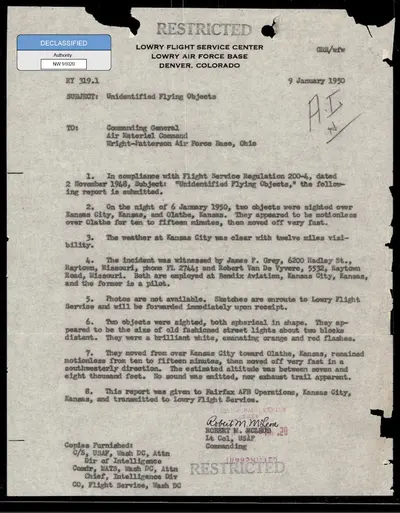
On November 17, 1948, a specific incident was recorded by U.S. government investigators in Edmonton, Alberta. The details of this encounter were not made available to the public until May 8, 2026, when they were released through the Presidential Unsealing and Reporting System for UAP Encounters (PURSUE). The documentation for this event is found within official U.S. Department of Defense files.
The primary account of the event comes from a radio operator stationed in Edmonton. This individual observed an object within the atmosphere that possessed a distinct physical profile. The object was described as being egg-shaped, measuring approximately 50 feet in height. The structure of the craft featured a notable taper, narrowing to a point at the tail. Visually, the object was characterized by a bright, flaming orange luminescence. While the observer was able to determine that the object was traveling in a southwest direction, the specific speed and exact heading of the craft remained unknown at the time of the report. The released documentation does not specify the total number of witnesses present during the observation.
Analytical Classification
The Edmonton case is classified as a visual sighting reported by ground or air observers. In the study of anomalous aerial phenomena, such cases are often analyzed alongside other visual reports of the same era to determine if a pattern of behavior or a common technological origin exists.
The status of this case remains unresolved. Under the protocols of the All-domain Anomaly Resolution Office (AARO), all records released via the PURSUE program are designated as unresolved by default. The federal government has maintained a neutral stance regarding the Edmonton sighting, neither concluding that the object was anomalous nor confirming that it was a conventional phenomenon.
When evaluating such reports, investigators consider several conventional candidates. These include experimental aircraft testing, which was frequent during the post-war period, or atmospheric optical phenomena such as sundogs and lenticular clouds that can create illusions of solid, moving objects. Additionally, astronomical bodies like Venus, the Moon, or meteors near the horizon are often scrutinized as potential sources for bright, luminous sightings. The lack of definitive data regarding the object’s velocity and the absence of corroborating sensor data prevent a conclusive determination of the object’s nature.