Ascension Parich UAP Encounter, 1948 — USAAF Box 7 #2
An archival record from 1948 details a U.S. Army Air Forces sighting of an unidentified object near Ascension Parich, Louisiana.
Historical Context of the 1948 Saucer Wave
The year 1948 represented a period of significant atmospheric and psychological transition in the United States. Following the summer of 1947, the American public and military establishment were grappling with a sudden influx of reports involving unidentified aerial phenomena. This era, often characterized by the “flying saucer” phenomenon, was precipitated by high-profile events such as the Kenneth Arnold sighting in June 1947 and the subsequent July 1947 Roswell incident. During this time, the distinction between conventional aerospace developments and truly anomalous objects remained blurred. The rapid advancement of aeronautical engineering, including the development of early jet propulsion and high-altitude reconnaissance capabilities, provided a backdrop of technological uncertainty.
The phenomenon was not merely a matter of visual sightings but also reflected the growing capabilities of radar technology. As air traffic increased and radar installations became more widespread, the ability to detect objects in the upper atmosphere expanded, often leading to the tracking of unidentified returns. This period saw the emergence of a specific type of public and military scrutiny regarding objects that exhibited flight patterns inconsistent with known contemporary aircraft. The widespread nature of these reports led to the formalization of tracking systems within various branches of the military, including the United States Army Air Forces.
The Ascension Parich Incident
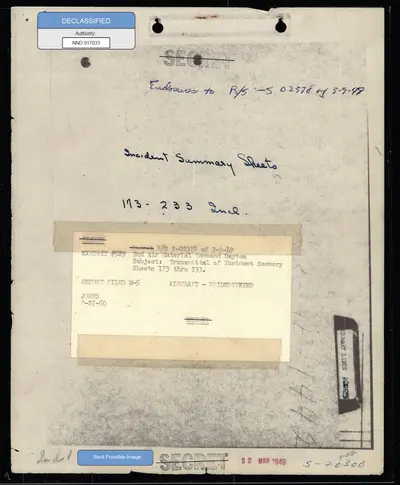
The Ascension Parich UAP Encounter, documented as USAAF Box 7 #2, remains a specific entry within the larger historical record of this era. The incident occurred in 1948 near Ascension Parich, Biles from Bew Orleans, La ver: B, B. Williams, Pres, United L. The details of the encounter were captured on an official U.S. Army Air Forces “Check-List - Unidentified Flying Objects” form. This specific document was part of a larger archival collection, specifically archived in Box 7 of file 3lam_143685.
The summary provided in the official record indicates that an unspecified observer reported a visual sighting of an unidentified object. The nature of the sighting was categorized as a visual observation, likely made by either ground-based or air-based observers. The specific details regarding the movement, shape, or duration of the object were not elaborated upon in the primary summary, which focused on the logging of the event within the military’s tracking series. The release of this information occurred much later, on May 8, 2026, through the Department of War as part of the Presidential Unsealing and Reporting System for UAP Encounters (PURSUE).
Investigation and Classification
The classification of the Ascension Parich event falls under the category of a visual sighting. In the context of 1940s-era investigations, such reports were often cross-referenced with known flight paths, weather patterns, and astronomical data. However, the official status of this case remains unresolved. Under the protocols of the All-domain Anomaly Resolution Office, all records released via the PURSUE program are designated as unresolved. The federal government has maintained a position of neutrality regarding the Ascension Parich encounter, neither concluding that the object was anomalous nor confirming it as a conventional phenomenon.
The difficulty in resolving such cases stems from the lack of multi-sensor data available during the 1948 period. While visual sightings were frequent, the integration of infrared, high-resolution imagery, and advanced telemetry was not yet a standard component of aerial monitoring. Consequently, investigators were often left to weigh the possibility of misidentified conventional objects against the possibility of unknown technology. Potential conventional explanations for sightings during this period include the Project Mogul balloon flights, which were active over the American Southwest, as well as experimental rocket and jet aircraft. Other possibilities included atmospheric optical effects or the misidentification of astronomical bodies at unusual viewing angles. The Ascension Parich record persists as a documented piece of this broader, unresolved historical inquiry.