Martinsburg, Best UAP Encounter, 1947 — USAAF Box 7 #218
A 1947 U.S. Army Air Forces report documents an unidentified object sighting near Martinsburg, Best, as part of the historic post-war saucer wave.
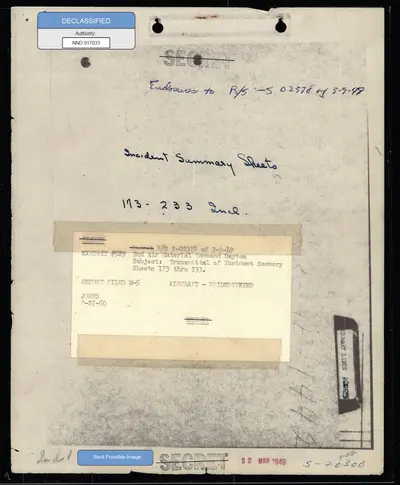
Background
In 1947, near Martinsburg, Best, the U.S. Army Air Forces recorded an unidentified-object incident that became Incident #218 in the “Check-List - Unidentified Flying Objects” series archived in Box 7 of file 38_143685. The records were released by the Department of War on May 8, 2026, as part of the Presidential Unsealing and Reporting System for UAP Encounters (PURSUE). This specific entry belongs to the foundational era of modern unidentified aerial phenomena studies, occurring during a period of intense atmospheric scrutiny following the end of World War II.
The timing of the Martinsburg sighting places it within the first wave of “flying saucer” reports that swept the United States throughout the summer of 1947. This phenomenon was catalyzed by the Kenneth Arnold sighting in June 1947 and the subsequent Roswell incident in July 1947. During this era, the sudden appearance of much-discussed aerial anomalies coincided with the dawn of the Jet Age, a period characterized by rapid advancements in aeronautical engineering and the deployment of new, high-altitude surveillance technologies. The public and military interest in such sightings was often driven by the tension of the early Cold War, where any unidentified movement in the skies could be interpreted as a potential threat from a foreign adversary.
What the form records
Incident #218 of the U.S. Army Air Forces “Check-List - Unidentified Flying Objects” series, archived in Box 7 of file 38_143685 and released by the Department of War on May 8, 2026, as part of the Presidential Unsealing and Reporting System for UAP Encounters (PURSUE), provides a concise administrative summary of the event. The summary records that an unspecified observer reported a sighting near Martinsburg, Best. Unlike more detailed investigative files that might include pilot testimony or radar data, this specific entry serves as a formal logging of the observation within the military’s standardized tracking system.
The documentation of such sightings in the mid-1940s was often characterized by a high degree of brevity. At the time, the military’s primary objective was to catalog potential incursions or technological anomalies that might interfere with established flight paths or national security. The lack of granular detail in the Martinsburg entry is consistent with the administrative nature of the “Check-List” series, which functioned more as a ledger of reported events than as a deep-dive investigative dossier.
Type of case
The case is classified as a visual sighting reported by ground or air observers. This category of encounter represents the most common form of UAP documentation from the 1947 era, relying on the naked-eye observations of individuals who noted unusual movement, light, or shape in the sky. Such sightings are inherently subjective and depend heavily on the environmental conditions, such as visibility, light pollution, and atmospheric clarity, at the moment of the encounter.
Status
All records released under the PURSUE program are designated unresolved by the All-domain Anomaly Resolution Office. The federal government has not concluded these 1947-era incidents were anomalous, has not concluded they were conventional, and has not ruled out either possibility. The lack of a definitive classification reflects the difficulty in retroactively analyzing decades-old visual reports without accompanying sensor data or corroborating radar tracks.
When evaluating the validity of such sightings, researchers often consider various conventional candidates that were active during the 1947 saucer wave. These include the Project Mogul balloon flights, which were then operating over the U.S. Southwest to detect Soviet nuclear tests, as well as the testing of experimental jet and rocket aircraft. Other possibilities frequently cited in the analysis of this era include atmospheric optical effects, such as sun dogs or temperature inversions, and the misidentification of astronomical objects, such as planets or meteors, viewed at unusual angles or through heavy cloud cover.