Japan UFO Sighting (September 5, 1947) — USAF Files
A 1947 radar detection of a flying saucer in Japan was documented in U.S. military records and later released via the PURSUE program.
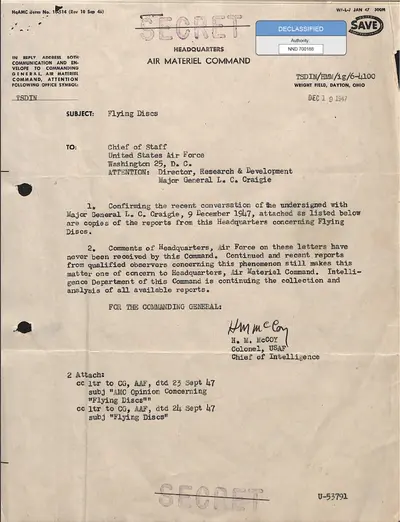
Background
On September 5, 1947, an unidentified-object incident occurred in Japan, as recorded by U.S. government investigators. The documentation regarding this event remained classified for decades, only becoming accessible to the public on May 8, 2026, through the Presidential Unsealing and Reporting System for UAP Encounters (PURSUE). This specific sighting emerged during a period of heightened global interest in aerial anomalies. The summer of 1947 was characterized by a significant surge in reported “flying saucer” phenomena, following the widely publicized Kenneth Arnold sighting in June 1947 and the subsequent Roswell incident in July 1947. As the United States and its allied interests in the Pacific were navigating the post-World War II landscape, the sudden appearance of unidentified aerial phenomena became a subject of scrutiny for military intelligence.
The geographic and geopolitical context of the Japan sighting is significant. In the late 1940s, Japan was under Allied occupation, and the presence of United States Air Force (USAF) assets and radar installations was a standard component of the regional security architecture. The monitoring of airspace was a critical function for the Army Air Forces, particularly as the Cold War began to solidify and the technological capabilities of various nations were being closely observed. The inclusion of this case in U.S. Department of Defense documents suggests that the detection was viewed as a matter of official interest to the military hierarchy stationed in the region.
Documented Observations
The primary evidence for this incident is contained within official U.S. military records, which describe an alleged flying saucer being sighted by a radar station located in Japan. The documentation indicates that this specific observation was discussed during a high-level conference attended by representatives from the Army Air Forces and Intelligence T-2. The involvement of Intelligence T-2, a division historically tasked with the analysis of aerial photography and intelligence gathering, underscores the official nature of the report. Despite the presence of such high-level military personnel at the conference, the released document provides no further specific details regarding the flight path, altitude, speed, or duration of the object’s presence.
The released paperwork does not provide a specific count of witnesses to the radar detection. While the radar station itself served as the point of detection, the document remains silent on whether any visual confirmation was reported by ground personnel or if the event was strictly a radar-only phenomenon. The lack of descriptive data regarding the object’s physical characteristics or behavior limits the ability to perform a detailed reconstruction of the event.
Classification and Analysis
This case is classified primarily as a radar track, a type of sighting where an unidentified object is detected via military or civilian radar equipment rather than through direct visual observation. Radar tracks are considered a specific subset of anomalous sightings because they rely on electromagnetic reflections that can sometimes be harder to dismiss as mere optical illusions. However, without accompanying visual data or telemetry, such tracks remain difficult to verify.
The status of the Japan sighting remains unresolved. Under the protocols of the All-domain Anomaly Resolution Office (AARO), all records released under the PURSUE program are designated as unresolved by default. The United States federal government has not issued a conclusion regarding whether the object was anomalous or conventional. In the context of the late 1940s, several conventional explanations were frequently considered for such sightings. These include the presence of experimental aircraft, weather balloons—most notably those associated with the Project Mogul series—and various atmospheric optical phenomena such as sundogs or lenticular clouds. Additionally, astronomical objects like the Moon, Venus, or meteors appearing near the horizon were often identified as potential sources for radar or visual anomalies during this era.
Sources
- [Original release on war.gov](https://www.war.gov/medialink/ufo/release_1/18_100754_ general 1946-7_vol_2.pdf)
- Department of War UFO Disclosure Portal
- AARO (All-domain Anomaly Resolution Office)