Cc, Attention UAP Encounter, 1947 — USAAF Box 7 #106
An archived U.S. Army Air Forces record details a 1947 unidentified object sighting near Cc, Attention, released via the PURSUE program in 2026.
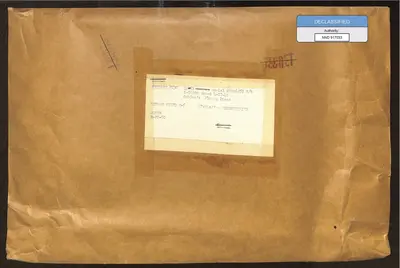
Archive Overview
The documentation known as USAAF Box 7 #106 represents a specific entry within the “Check-List - Unidentified Flying Objects” series maintained by the U.S. Army Air Forces. This particular record, archived within Box 7 of file 38_143685, details an unidentified-object incident occurring in 1947 near the location identified as Cc, Attention. The existence of this file remained obscured from public view until May 8, 2026, when the Department of War released the records as part of the Presidential Unseponymous and Reporting System for UAP Encounters (PURSUE). The entry serves as a primary source document for researchers studying the early post-war era of aerial phenomena.
Historical Context of the 1947 Wave
The year 1947 is recognized in aeronautical history as a pivotal period for the emergence of unidentified aerial phenomena in the United States. This era was characterized by a sudden surge in reports of disc-shaped objects, a phenomenon often referred to by historians as the “flying saucer” wave. This period of heightened public and military awareness was catalyzed by high-profile events, most notably the Kenneth Arnold sighting in June 1947 and the widely discussed Roswell incident in July 1947. During this time, the rapid advancement of aeronautical technology following World War II created a landscape where the distinction between known experimental craft and unknown phenomena was frequently blurred.
The military and scientific communities of the late 1940s were navigating a transition from propeller-driven aviation to the dawn of the jet age. This technological shift, combined with the onset of the Cold War, necessitated rigorous monitoring of the national airspace. Consequently, the U.S. Army Air Forces maintained various checklists and observation logs to track objects that did not conform to known flight patterns or identifiable signatures. Case #106 is a product of this systematic effort to catalog aerial anomalies that appeared during this period of intense atmospheric observation.
Incident Details and Classification
The specific contents of Incident #106 are contained within the summary records of the “Check-List - Unidentified Flying Objects” series. The document records that an unspecified observer reported a sighting in the vicinity of Cc, Attention. The nature of the report is classified as a visual sighting, a type of encounter documented by either ground-based or air-based observers. While the document confirms the occurrence of the sighting and its location, the specific characteristics of the object and the exact nature of the observer’s vantage point remain as recorded in the original military summary.
As a visual sighting, the case falls into a category of phenomena that rely on the optical perception of an observer. Such reports were common during the 1947 wave and were often scrutinized for their ability to be corroborated by radar or secondary visual witnesses. In the case of #106, the record provides the foundational data of the sighting’s existence within the military’s tracking system but does not expand upon the physical properties of the object beyond its initial reporting.
Investigative Status and Anomalous Analysis
The status of Case #106 remains officially unresolved. Under the protocols of the All-domain Anomaly Resolution Office, all records released through the PURSUE program are designated as unresolved. The federal government has maintained a position of neutrality regarding the nature of this 1947 encounter; the archives do not conclude that the object was anomalous, nor do they conclude that it was a conventional craft. The possibility of either an unidentified phenomenon or a known technological entity remains open.
When evaluating the 1947-era sightings, investigators often consider several conventional candidates. During this period, the United States Southwest was the site of Project Mogul, a series of high-altitude balloon flights designed to detect Soviet nuclear tests. Additionally, the development of experimental jet and rocket aircraft, as well as various atmospheric optical effects and the misidentification of astronomical objects at unusual angles, provide a framework for conventional explanations. Case #106 remains part of this ongoing analytical effort to differentiate between known aeronautical activity and truly unidentified aerial phenomena.