Kenneth Arnold UFO Sighting, Cascade Mountain Range, Washington State (July 12, 1947)
A 1947 government report details Kenneth Arnold's observation of nine unidentified objects flying over Washington's Cascade Mountain Range.
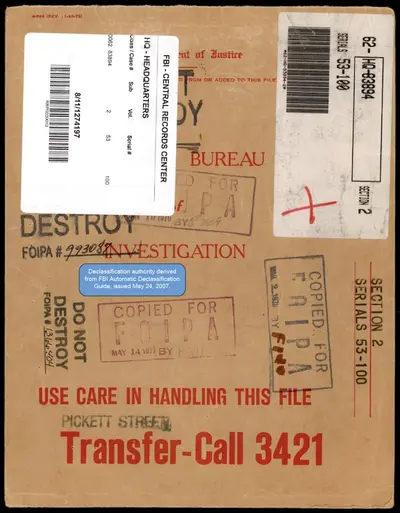
Historical Context
The mid-twentieth century represented a transformative period for aerial surveillance and the public’s perception of the upper atmosphere. Following the conclusion of World War II, the rapid advancement of aeronautical technology, including the development of jet propulsion and high-altitude reconnaissance, created a landscape where unidentified aerial phenomena could easily be mistaken for clandestine military hardware. During this era, the United States government was deeply engaged in monitoring the skies for both conventional and unconventional threats, often utilizing various intelligence agencies to track objects that deviated from known flight paths. This period of heightened atmospheric scrutiny coincided with a surge in public interest regarding unidentified flying objects, a phenomenon fueled by a series of high-profile reports that suggested the presence of technology far beyond contemporary civilian capabilities.
The July 1947 Incident
On July 12, 1947, within the Cascade Mountain Range of Washington State, an unidentified-object incident occurred that was later documented by United States government investigators. The details of this encounter were not made available to the general public until May 8, 2026, when they were released through the Presidential Unsealing and Reporting System for UAP Encounters (PURSUE). This specific sighting emerged during a period of intense aerial anomaly reports, following closely on the heels of the Kenneth Arnold sighting in June 1947 and the widely discussed Roswell incident in July 1947. These events collectively contributed to the “flying saucer” phenomenon that characterized much of the American media landscape during the summer of 1947.
The official documentation records that Kenneth Arnold observed nine strange objects moving through the airspace above the Cascade Mountains. The released file provides specific details regarding the flight characteristics of these objects, though it does not provide a specific count of other witnesses to the event. The report is notable for capturing the personal sentiment of the observer, noting that Arnold was highly vocal regarding the perceived inadequacy of the official response. The file contains a verbatim notation stating that Mr. Arnold was very outspoken and somewhat bitter in his opinions of the leaders of the United States Army Air Forces and the FBI for not having made an investigation of this matter sooner.
Investigative Procedures and Classification
At the time of the report, the investigative framework for such sightings was managed through established bureaucratic channels. The case was filed with the Federal Bureau of Investigation, which utilized a standardized protocol for handling reports of this nature. Field offices in cities such as Knoxville, Albuquerque, and Los Angeles were responsible for routing UFO reports to the FBI headquarters, particularly when the reports involved the potential protection of vital installations or national security interests. This structured approach ensured that sightings occurring near sensitive military or industrial sites were centralized for analysis by federal authorities.
The nature of the case is classified as a visual sighting reported by ground or air observers. Under the current regulatory framework established by the All-domain Anomaly Resolution Office (AARO), all records released under the PURSUE program are designated as unresolved by default. The federal government maintains a neutral stance regarding the 1947 Cascade Mountain Range incident, as it has not concluded that the events were anomalous, nor has it concluded that they were conventional.
Potential Explanations
When evaluating sightings from the late 1940s, researchers often consider a variety of conventional candidates. The era was marked by significant atmospheric and technological activity. Potential explanations for such sightings include the presence of experimental aircraft or the widespread use of weather balloons, specifically those associated with the Project Mogul series, which utilized high-altitude balloons to detect Soviet nuclear tests. Other natural phenomena, such as atmospheric optical effects including sundogs and lenticular clouds, are frequently cited as possible causes for misidentifications. Additionally, astronomical objects such as Venus, the Moon, or meteors appearing near the horizon can mimic the appearance of moving aerial objects. Despite these possibilities, the specific flight characteristics noted in the Arnold report remain a subject of historical record within the archive.