Bollin field UFO Sighting (July 7, 1947) — FBI Files
FBI records document an unidentified object sighting over Bollin Field, Washington, D.C., occurring during the height of the 1947 flying saucer wave.
Background
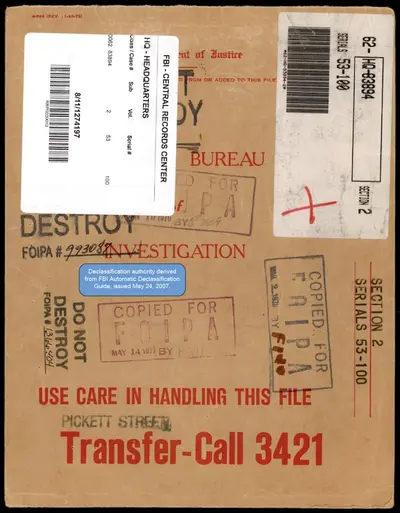
On July 7, 194 and, in Bollin field, Washington, D. C., U.S. government investigators recorded an unidentified-object incident later released to the public on May 8, 2026 as part of the Presidential Unsealing and Reporting System for UAP Encounters (PURSUE). This event occurred during a period of heightened public and military anxiety regarding unidentified aerial phenomena. The summer of 1947 is widely recognized in paranormal historiography as the beginning of the first major wave of “flying saucer” reports that swept the United States. This wave was catalyzed by the Kenneth Arnold sighting in June 1947 and the subsequent Roswell incident in July 1947. During this era, the presence of unidentified objects in the sky was often viewed through the lens of post-war technological competition, with many speculating on the existence of advanced, secret aeronautical developments.
The administrative handling of the Bollin field incident reflects the bureaucratic landscape of the mid-twentieth century. The case was filed with the Federal Bureau of Investigation, whose Knoxville, Albuquerque, Los Angeles, and other field offices routed UFO reports to headquarters under the Bureau’s standing protocols for the protection of vital installations. At the time, the identification of aerial anomalies was treated as a matter of national security, particularly when sightings occurred near the nation’s capital or significant military infrastructure. The centralized reporting structure ensured that sightings of potential significance were funneled to federal investigators for scrutiny.
What the document records
The primary documentation for this event consists of a memorandum issued by the War Department, titled “Report on Flying Saucers,” which was addressed to the 32d AA Base Unit. This specific report details incidents occurring in the vicinity of Lily Lake. Within the scope of this memorandum, the FBI was tasked with investigating Richard F. Shaver, a resident living near Lily Lake, to gather information regarding the reported flying discs. The inclusion of Shaver in the investigative scope suggests that authorities were looking into local individuals who may have possessed specific knowledge or observations regarding the phenomena.
While the memorandum provides details regarding the geographic focus of the investigation and the involvement of specific personnel, the released document does not specify the number of witnesses involved in the Bollin field sighting. The nature of the documentation is primarily focused on the investigative directives and the connection to the Lily Lake area rather than a detailed eyewitness testimony log.
Type of case
The Bollin field incident is classified as a visual sighting reported by ground or air observers. Such sightings are common in the historical record of unidentified aerial phenomena, as they rely on the direct observation of light, shape, or movement against the sky.
Status
All records released under the PURSUE program are designated unresolved by the All-domain Anomaly Resolution Office (AARO) by default. The federal government has not concluded that the events were anomalous, has not concluded that they were conventional, and has not ruled out either possibility. The investigation into the July 7 incident remains open in a historical sense, as no definitive explanation was reached in the contemporaneous reports.
During the late 1940s, researchers and investigators often weighed these sightings against several conventional candidates. These included experimental aircraft developed during the transition to the jet age, weather balloons—specifically those associated with the Project Mogul series in the late 1940s—and various atmospheric optical phenomena such as sundogs and lenticular clouds. Additionally, astronomical objects including Venus, the Moon, and meteors near the horizon were frequently considered as potential sources for reported unidentified objects. The Bollin field case remains a significant piece of the 1947 archival record, representing the intersection of military surveillance and the burgeoning phenomenon of unidentified aerial objects.