Godman AFB, Ft Knox UFO Sighting (7 February 1919) — USAF Files
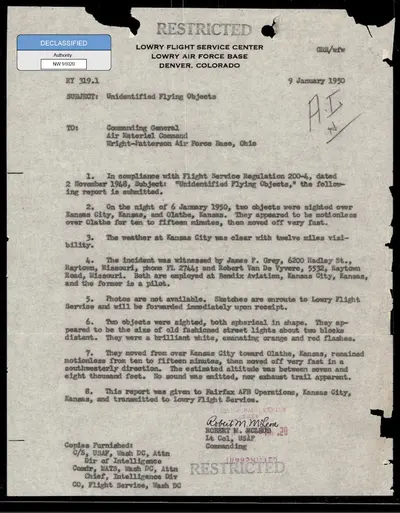
U.S. government documents record an unidentified flying object sighting at Godman AFB and Ft. Knox, Kentucky, on February 7, 1919.
Historical Context
The sighting at Godman Air Force Base and Fort Knox occurred during a transformative era in aeronautical history. In early 1919, the concept of fixed-wing flight was still in its infancy, and the boundaries of aerial capability were being redefined almost daily. The period immediately following the First World War saw a rapid transition from rudimentary reconnaissance biplanes to more sophisticated engine designs. Because the technological baseline for what constituted a legitimate aerial vehicle was so unstable, any object moving through the sky with unusual characteristics or speeds would naturally trigger intense scrutiny from military observers.
During this era, the distinction between atmospheric phenomena, celestial bodies, and man-made machines was often difficult to maintain without the aid of modern radar or high-speed photography. The geography of Kentucky, particularly the military installations around Fort Knox, provided a concentrated environment of trained observers capable of noting deviations in the sky. At the time, the presence of unusual lights or moving objects was often analyzed through the lens of emerging meteorology or the potential for secret military developments, as the secrecy surrounding post-war aviation technology was significant.
The Incident of February 7, 1919
According to U.S. Department of Defense documents, an unidentified flying object was sighted at Godman AFB and Fort Knox on February 7, 1919. The official record indicates that the weather conditions during the event were clear, providing good visibility for anyone observing the sky. Despite the clarity of the atmosphere, the documentation lacks any accompanying visual evidence, such as photographs or sketches, to provide a definitive description of the object’s shape, size, or luminosity.
The released documents do not specify the exact number of witnesses present during the sighting. The report emerged from an investigation conducted by U.S. government investigators, though the specific identities of those who made the observation remain unlisted in the accessible files. This specific case file was later released to the public on May 8, 2026, as part of the Presidential Unsealing and Reporting System for UAP Encounters (PURSUE). The sighting is categorized as a visual sighting reported by either ground-based or air-based observers stationed at the military installation.
Analytical Framework and Classification
The case remains categorized as an unidentified-object incident. Under the current protocols of the All-domain Anomaly Resolution Office (AARO), all records released under the PURSUE program are designated as unresolved by default. This means the federal government has not reached a definitive conclusion regarding whether the object was an anomaly or a known phenomenon. The official stance maintains that the event could be either conventional or otherwise, leaving both possibilities open for future study.
When evaluating sightings from the early twentieth century, investigators often consider several conventional candidates. These include experimental aircraft that were being tested in secrecy, weather balloons, or various atmospheric optical phenomena. For instance, phenomena such as sundogs, lenticular clouds, or even the appearance of planets like Venus and the Moon near the horizon can mimic the appearance of moving objects. While later eras saw the use of sophisticated tools like the Project Mogul balloon series to monitor the upper atmosphere, the 1919 sighting lacks the technological context to rule out such atmospheric or astronomical explanations. The lack of corroborating data remains the primary obstacle in distinguishing this event from the broader spectrum of documented aerial anomalies.