H.M.S. Caroline UFO Sighting (May 25, 1893) — FBI Files
An 1893 maritime report from the H.M.S. Caroline describes unusual lights forming irregular lines and crescent shapes, later released via the PURSUE program.
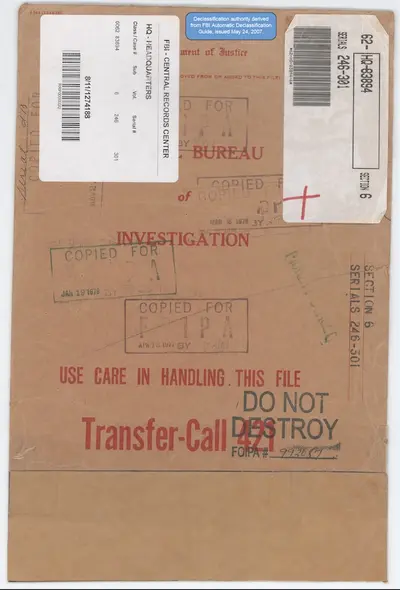
Historical Context and Documentation
The sighting recorded on May 25, 1893, aboard the H.M.S. Caroline represents a significant archival entry within the history of aerial anomalies. The documentation regarding this event was released to the public on May 8, 2026, through the Presidential Unsealing and Reporting System for UAP Encounters, known as PURSUE. This specific case is classified as a pre-modern apparition or aerial-anomaly account, a category of phenomena that predates the formal, scientific study of Unidentified Aerial Phenomena (UAP) that emerged during the mid-twentieth century.
The archival trail for this incident is maintained by the Federal Bureau of Investigation. Under the Bureau’s long-standing protocols for the protection of vital installations, various field offices, including those in Knoxville, Albuquerque, and Los Angeles, have historically routed UFO reports to headquarters for centralized processing. This administrative structure ensures that anomalous reports involving maritime or terrestrial security are cataloged within the federal intelligence framework, even when the nature of the observed object remains unknown.
The Incident of May 25, 1893
The details of the event occurred during a wintry cruise of the H.M.S. Caroline. According to the official records, the officer of the watch reported the presence of unusual lights. The documentation describes a specific sequence of movement and formation changes. Initially, the lights were observed as a singular mass. This mass subsequently transitioned into an irregular line. The behavior of the lights continued to shift, at certain intervals grouping together into clusters, and at other periods arranging themselves into a distinct crescent of diamonds.
While the visual characteristics of the lights were documented with specific geometric descriptions, the released files do not provide a specific number of witnesses to the event. The primary evidence remains the verbatim excerpt from the file, which states that during the recent cruise, a curious phenomenon was seen and that these unusual lights were reported by the officer of the watch.
Analytical Framework and Classification
The case is categorized as a visual sighting reported by observers. In the late nineteenth century, such sightings were often interpreted through the lens of atmospheric science or maritime superstition rather than aeronautical study. Because the era lacked the technology for high-altitude photography or radar, such reports relied entirely on the naked-eye observations of trained personnel, such as naval officers.
The All-domain Anomaly Resolution Office (AARO) has designated all records released under the PURSUE program as unresolved by default. The federal government has maintained a neutral stance regarding the H.M.S. Caroline incident, neither concluding that the lights were anomalous nor confirming that they were the result of conventional phenomena. The possibility of both interpretations remains open within the official record.
When evaluating sightings from this historical period, researchers often consider several conventional candidates. These include atmospheric optical phenomena, such as sundogs, or lenticular clouds, which can create strange shapes in the sky. Astronomical objects like the Moon, Venus, or meteors near the horizon are also frequent subjects of investigation. While later eras saw the emergence of experimental aircraft or weather balloons, such as the Project Mogul series in the late 1940s, the 1893 sighting remains an isolated instance of unexplained light formations in the maritime record.