FBI UAP Sensor Imagery: 32 Government-System Captures Submitted to AARO (2024)
Between 2024 and 2025, the Federal Bureau of Investigation submitted thirty-two still images of unidentified anomalous phenomena to the All-domain Anomaly Resolution Office. Each was derived from a U.S. government sensor system, redacted before submission, and accompanied by a brief AARO-issued narrative description. The dates and locations of the underlying events have not been disclosed.
A Quiet Submission, Thirty-Two Images Long
Between 2024 and 2025, in a series of separately filed reports, the Federal Bureau of Investigation submitted thirty-two still images of unidentified anomalous phenomena to the All-domain Anomaly Resolution Office. Each image was, in AARO’s published phrasing, “derived from a U.S. government system” — sensor imagery captured during the routine operation of a federal platform whose nature, location, and mission have been redacted from the public version of the file. The original imagery was altered with redactions before submission, and no accompanying mission report was provided. The operators, whoever they were, reported in each case that they were unable to positively identify the object visible in the frame.
The images were declassified and released as part of the May 8, 2026 Department of War Presidential Unsealing and Reporting System for UAP Encounters (PURSUE) tranche, alongside the historical FBI vault holdings and the AARO modern document set. Unlike the narrative incident files that dominate the rest of the corpus, these thirty-two records consist of imagery first and text second. Each is accompanied only by a short AARO-issued narrative description of what the frame shows — typically a sentence or two about the position of the object within the sensor’s crosshair reticle and the texture of the surrounding background. The descriptions are unusually careful in their language. AARO appends a standard disclaimer to each: “Readers should not interpret any part of this description as reflecting an analytical judgment, investigative conclusion, or factual determination regarding the described event’s validity, nature, or significance.”
What the Images Show
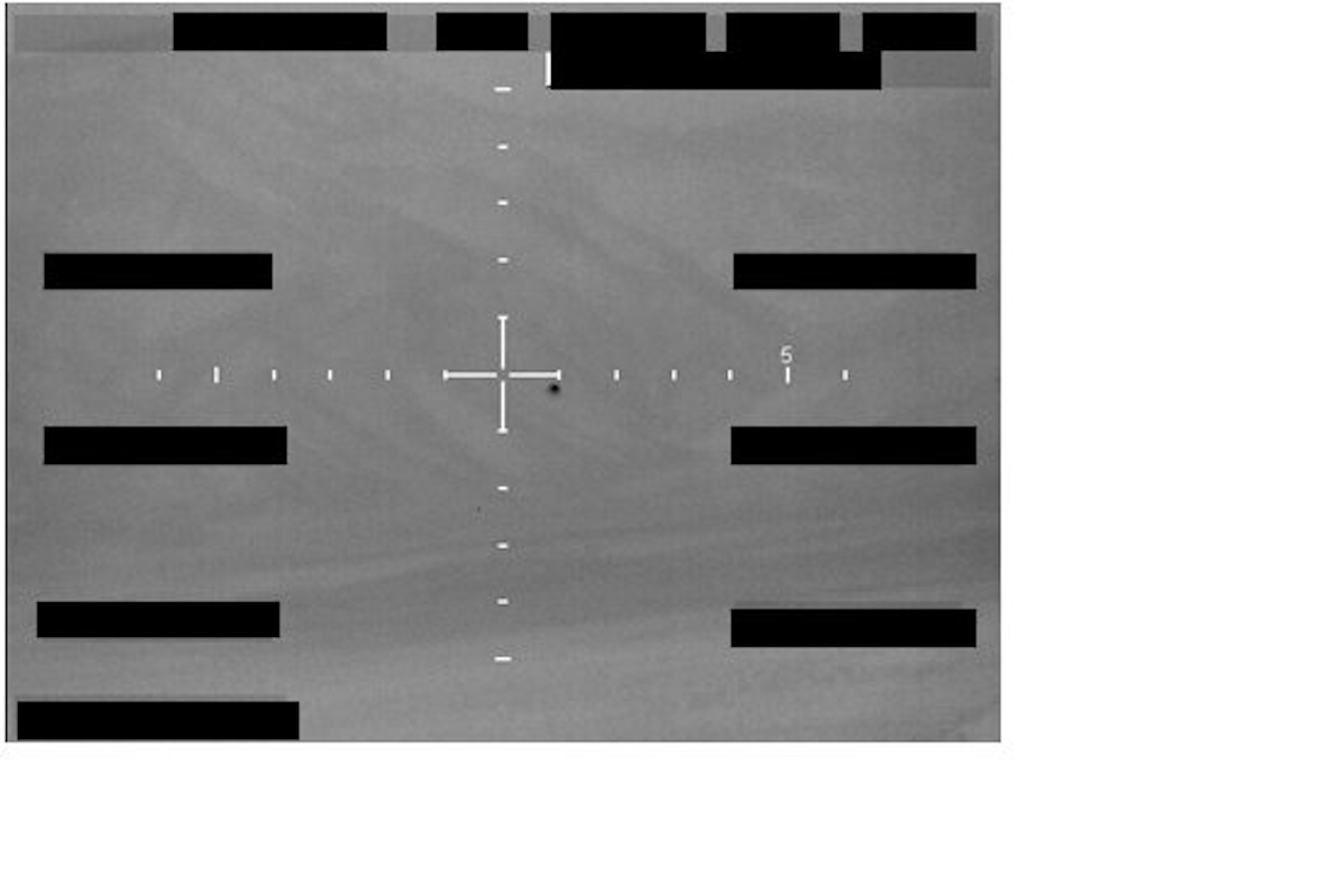
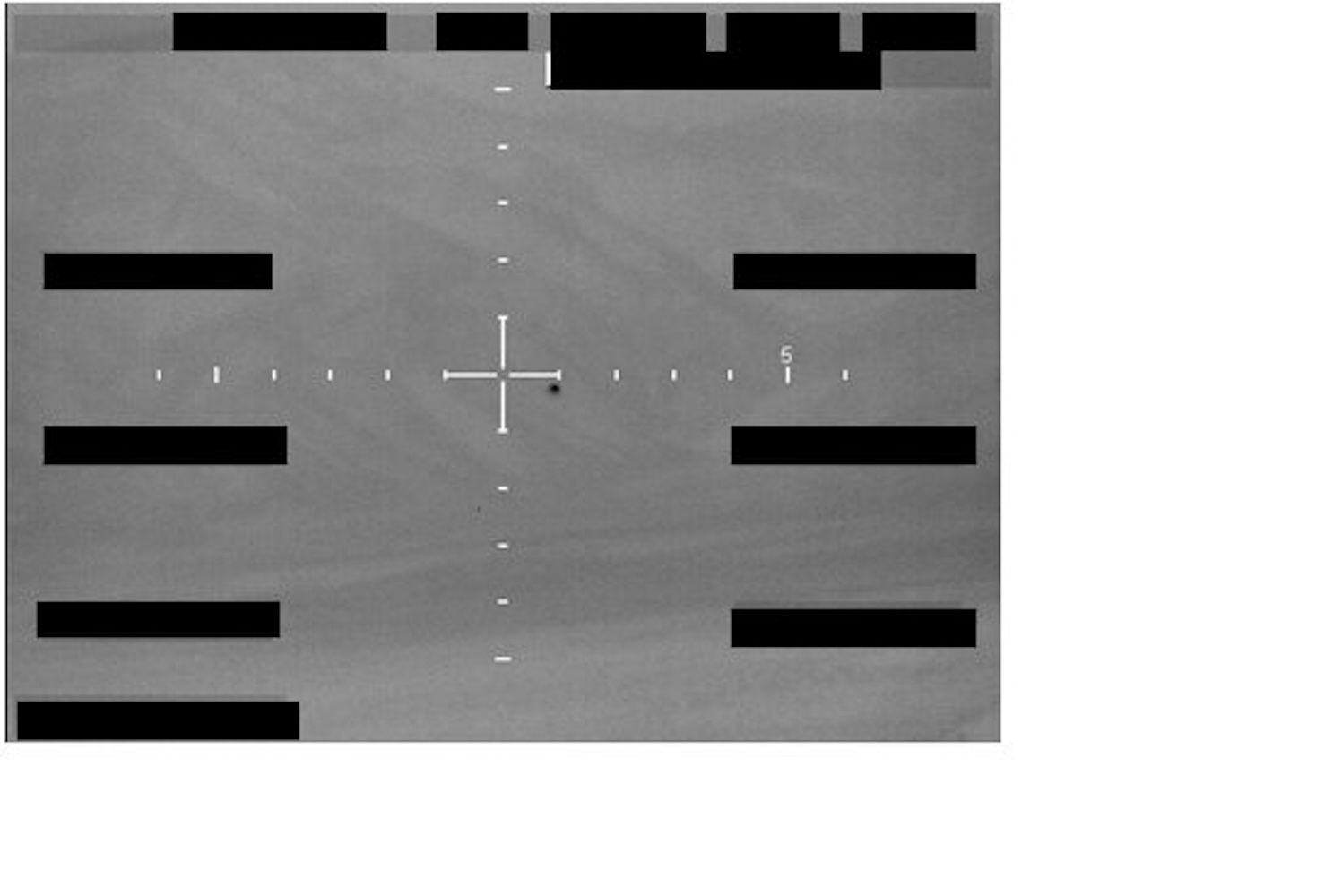
The visual signature is consistent across all thirty-two frames. Each is a monochrome capture from what appears to be an electro-optical or infrared sensor, displayed with the standard reticle, range marks, and graduated scale of a military targeting system. Heavy black redaction bars are placed across the upper and side margins of each image, obscuring data fields that would normally identify the platform, the time, the geographic coordinates, and the bearing. The redactions are thorough and consistent in placement, suggesting they were applied as a single processing step before submission rather than improvised case by case.
Within the frame itself, the central feature is invariably a dark, roughly circular object positioned in or near the crosshair. AARO’s narrative descriptions vary the geometric details — “exactly at the center of the reticle,” “just below and to the right of center,” “located at the bottom quadrant,” “positioned at the center” — but the qualitative description is the same: a small, dark, slightly irregular shape against a textured background. The backgrounds themselves vary. Some are described as “lightly textured,” some as “mottled,” some as “densely speckled,” and some as “uneven, suggesting a varied landscape or surface.” Whether the textures represent terrain, cloud cover, water, or some other medium is not specified.
The images are catalogued in two series. Series A contains the first eight frames, A1 through A8. Series B contains the remainder, B1 through B16 and beyond, with the catalog continuing through additional letter prefixes in some indexes. Whether the series correspond to distinct platforms, distinct events, distinct geographic theaters, or merely chronological order of submission is not stated. The visual continuity across the collection is consistent enough to suggest a common sensor type, but the variation in background texture is consistent with imagery collected from different platforms or different operating environments.
What the Images Don’t Show
The most striking feature of the collection is what has been removed. The dates of the events are absent. The locations are absent. The platforms are absent. The mission contexts are absent. The names of the operators are absent. What remains is the irreducible visual core of each report — a sensor frame with a dark object in or near the crosshair — and AARO’s brief, deliberately neutral narrative caption.
This pattern of submission is itself a kind of disclosure. The Federal Bureau of Investigation, an agency not historically known for sharing operational sensor imagery with civilian or quasi-civilian oversight bodies, agreed to send these frames to AARO. AARO, in turn, agreed to publish them in a redacted form rather than retain them only in classified channels. The decision to release the images at all, even with all identifying context stripped, represents a willingness on the part of two federal agencies to acknowledge the existence of imagery that they cannot or will not explain in unclassified text. The disclaimer attached to each description — that the description should not be read as an analytical or investigative judgment — leaves open the possibility, but only the possibility, that classified analysis exists elsewhere.
Status of the Cases
All thirty-two images are catalogued as unresolved by AARO. The narrative descriptions explicitly note that the operators in each case were unable to positively identify the objects depicted. AARO has not, in the released material, attributed any of the images to commercial drones, classified test platforms, balloon traffic, satellite re-entry, atmospheric optical phenomena, or other prosaic candidates. The conventional explanations remain on the table — sensor artifacts in particular are a known source of false-positive reports, and crosshair-centered dark objects can in principle be produced by dust, internal optics, lens flares, or pixel defects — but AARO does not, in the public material, advance any of those explanations.
What can be said with reasonable confidence is that someone, operating a U.S. government sensor system in some redacted theater of operations, recorded an object in the crosshair, was unable to identify it, and forwarded the imagery up the chain. Thirty-one further frames followed by the same channel under the same conditions. Whether they show the same object, similar objects, or a recurring sensor artifact remains unresolved. The frames are part of the public record now, and the determination is left, as AARO’s disclaimer explicitly states, to the reader.