Chuchunya, The Siberian Wildman
The Yakut and Evenk peoples of northeastern Siberia describe Chuchunya as a tall, hair-covered, fur-clad outsider seen on the tundra fringe — a figure modern researchers have linked variously to a relict hominid, a surviving indigenous group, or pure folklore.
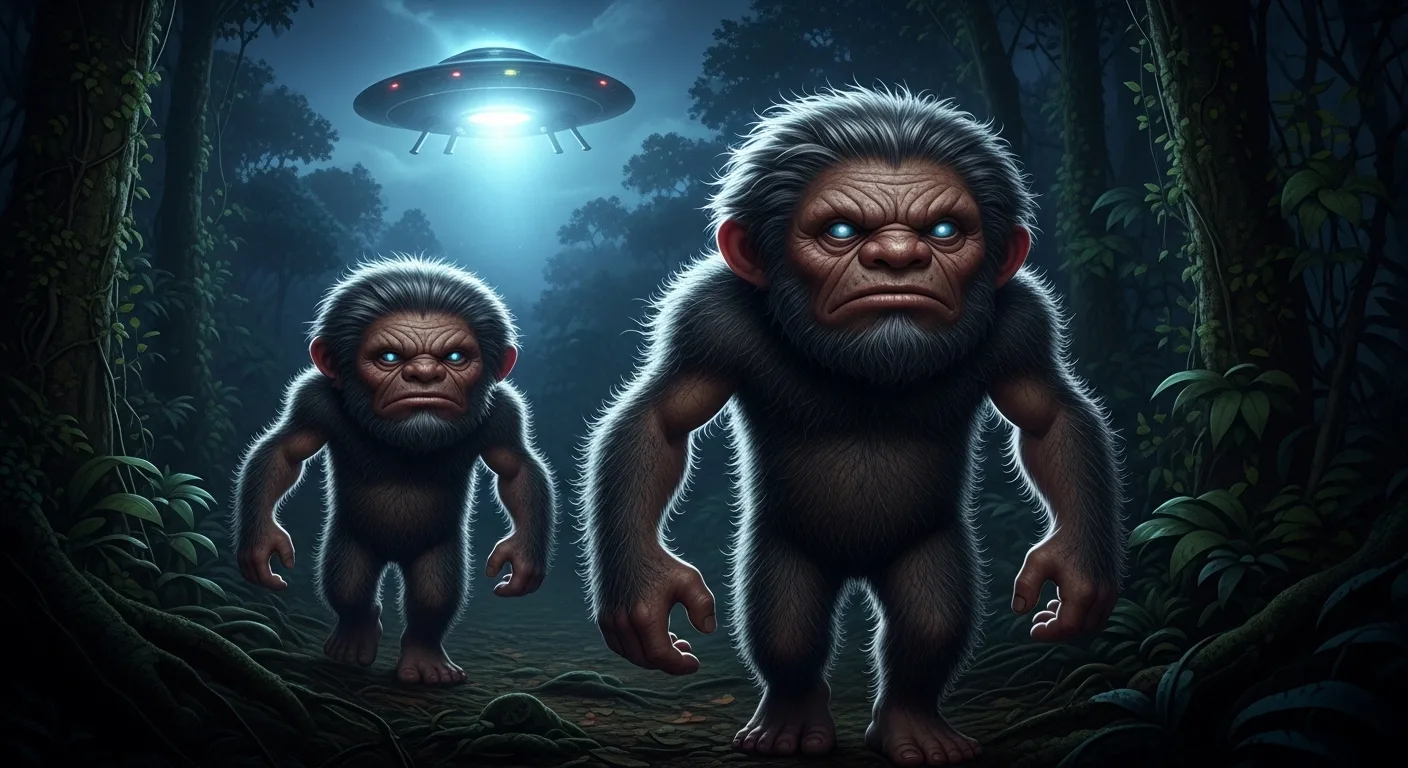
In the vast taiga and tundra of northeastern Siberia, among the Yakut, Yukaghir, and Evenk peoples whose territories extend from the Lena River to the Arctic coast, there is a long-standing tradition of an outsider who lives at the edge of the world. The Yakut name him Chuchunya, sometimes rendered Chuchunaa. The Evenk speak of a similar figure under the name Mulen. Russian explorers and ethnographers from the nineteenth century onward have collected accounts of Chuchunya from indigenous informants and have, on occasion, reported encountering the figure themselves. He is described as tall, sometimes very tall, covered in dark hair from the shoulders down, dressed in skins or roughly stitched fur, and possessed of a peculiar lurching run that allows him to outpace a reindeer over open ground. He avoids settlements but is sometimes seen on the periphery of fishing camps or at the edge of summer pastures, watching from the tree line and retreating without confrontation.
Chuchunya occupies a distinctive position among the world’s wild-man legends. Unlike the Almasty of the Caucasus or the almas of the Mongolian steppe, with whom he is sometimes grouped, the Chuchunya tradition retains a sharp ambiguity about whether the figure is a relict animal, a surviving population of an unknown human group, or a culturally constructed personification of the hostile outsider that any subsistence community must hold in mind. The Russian ethnographic record is large enough that the question cannot be settled by reference to oral tradition alone, but the answer offered by that record is itself worth examining.
The Earliest Russian Accounts
The first documented Russian-language reference to Chuchunya appears in the writings of nineteenth-century explorers of the Arctic Siberian coast. In the 1840s and 1850s, expedition members under Pyotr Anjou and others noted the existence of native traditions concerning a tall, hair-covered figure that lived on the tundra. The accounts were generally treated as folklore, although several Russian officers reported having seen, at a distance, what they took to be a Chuchunya. None of these early reports produced physical evidence, and the sightings were not pursued systematically.
More substantial documentation came in the early twentieth century, when Soviet anthropologists conducting surveys in the Sakha Republic recorded a number of detailed accounts. The geologist P. L. Dravert, working in the 1920s, published several reports collected from Yakut and Yukaghir informants. The figure they described was approximately two meters in height, sometimes more, with a low forehead, prominent brow ridges, and powerful arms. He spoke a language no Yakut understood, although in some accounts he was said to know a few words of Yakut and to use them in his rare communications with hunters. He carried no manufactured weapon other than a stone knife or club. His diet, according to local informants, consisted of fish, berries, and the occasional reindeer taken from a herder’s stock by stealth.
A Surviving Population, Or A Misunderstood Neighbor?
Several lines of interpretation have been advanced for the Chuchunya tradition. The most prosaic, advanced by Soviet-era ethnographers including A. P. Okladnikov, holds that Chuchunya represents the cultural memory of a now-vanished indigenous group, possibly a remnant of the Yukaghir population pushed into marginal territory by the expansion of the Yakut and the Evenk, or possibly a small surviving band of hunter-gatherers from a still earlier cultural horizon. On this reading, Chuchunya was a real human being seen at a distance, dressed in clothing his observers did not recognize, and ascribed by them to the supernatural by the same process that has often turned outsiders into monsters in any oral tradition.
A second interpretation, popular among Russian cryptozoologists from the 1950s onward, treats Chuchunya as a relict hominid, possibly a surviving population of Homo neanderthalensis or of an unknown collateral lineage of Homo. The most influential proponent of this view was the historian Boris Porshnev, whose 1963 monograph The Current State of the Question of Relict Hominoids synthesized the Chuchunya reports together with the almas and the almasty into a coherent zoogeographic argument for the continued existence of an archaic human species across the mountainous and remote regions of the Eurasian interior. Porshnev’s arguments are now considered unpersuasive by mainstream paleoanthropology, which finds no genetic or fossil evidence for surviving Neanderthals or other archaic hominids in the Holocene, but the framework continues to shape Russian cryptozoological discourse.
A third interpretation, advanced by folklorists, treats Chuchunya simply as a figure of cautionary moral storytelling, a personification of the dangers of the wilderness used by Yakut and Evenk parents to keep children close to camp. This reading does not require physical reality at all, although it does not, in principle, exclude it either.
Twentieth-Century Encounters
The published Soviet record contains a small but persistent body of twentieth-century encounter reports. In 1928, a hunting party near the Indigirka River reported sighting a figure of unusual height running across an open clearing and disappearing into the forest. In 1936, a geological expedition in the Verkhoyansk Mountains reported tracks in the snow that were broadly humanoid in form but considerably larger than would be expected for a Yakut hunter, and which extended for several kilometers across difficult terrain. In 1959, the same year as the Dyatlov Pass incident several thousand kilometers to the southwest, a Yakut reindeer herder reported a face-to-face encounter with a Chuchunya near Lake Esei, although his account was not published until decades later and includes details that may have been retrospectively shaped by intervening exposure to broader cryptozoological traditions.
The most thoroughly investigated modern account is that of the geologist N. F. Pomortsev, who in 1971 reported observing a tall hair-covered figure on a ridge in the Suntar-Khayata range. Pomortsev described the figure as approximately two and a half meters tall, with arms extending below the knees and a sloping forehead, and reported watching it for several minutes through binoculars before it descended the far side of the ridge. His account was published in the regional geological journal in a brief, sober note and has been cited by Russian cryptozoologists ever since as one of the better-documented sightings on record.
A Cautious Assessment
The Chuchunya file, like every other relict hominid tradition, rests on testimony rather than physical evidence. No remains have ever been examined under modern forensic conditions. No verified photograph exists. The tracks reported in 1936 and on subsequent occasions have not survived in a form that allows reanalysis. The probability that Chuchunya represents a surviving non-modern hominid is, on present evidence, very low. The probability that he represents misperceived encounters with members of a small surviving indigenous group, or a powerful piece of cautionary folklore, or some combination of the two, is considerably higher. The Russian Far East, however, is a region whose remoteness still places certain claims beyond the reach of ordinary scientific verification, and the Chuchunya file is best understood as a question that the available data do not allow us to close.
Sources
- Porshnev, B. F., The Current State of the Question of Relict Hominoids, Moscow, 1963.
- Dravert, P. L., field notes published in Sibirskie Ogni, 1925–1933.
- Bayanov, Dmitri, In the Footsteps of the Russian Snowman, Crypto-Logos, 1996.
- Shackley, Myra, Still Living? Yeti, Sasquatch and the Neanderthal Enigma, Thames & Hudson, 1983.