Iraq Military UAP Encounter (September 2024) — Mission Report
A September 2024 mission report from Iraq details a visual UAP sighting released via the PURSUE program in 2026.
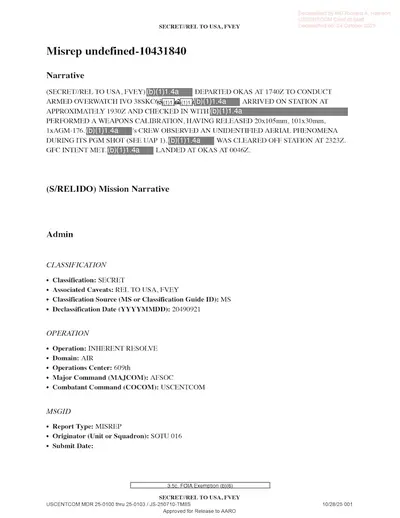
Overview of the Incident
In September 2024, within the airspace or territory of Iraq, U.S. government investigators recorded an unidentified-object incident. The details of this encounter were later released to the public on May 8, 2026, as part of the Presidential Unsealing and Reporting System for UAP Encounters (PURSUE). The documentation regarding this event is contained within official U.S. Department of Defense records. The case is classified as a visual sighting, reported by observers positioned either on the ground or within aircraft. While the documentation provides specific details regarding the nature of the report, the released document does not specify the exact number of witnesses involved in the sighting.
Administrative Context and Disclosure
The emergence of this case is a product of the modern UAP investigative apparatus, specifically following the 2022 establishment of contemporary oversight frameworks. This incident belongs to the disclosure era associated with the All-domain Anomaly Resolution Office (AARO). The administrative framework governing this report is the Mission Report (MISREP), which serves as a standardized reporting form utilized by the United States military to document the circumstances surrounding its various operations. This standardized format ensures that anomalies encountered during active duty are recorded with technical precision, even when the nature of the object remains unknown.
The release of this information via the PURSUE program represents a specific phase of government transparency regarding Unidentified Anomalous Phenomena. Under the protocols of this program, all records released are designated as unresolved by the AARO by default. This classification indicates that the investigative process has not reached a definitive conclusion regarding the identity or origin of the object. The federal government has maintained a neutral stance, neither concluding that the observed events were anomalous nor confirming that they were the result of conventional technology.
Comparative Analysis and Potential Classifications
The investigation of such sightings must be viewed within the broader history of aerial anomaly reporting. Historically, military-documented sightings have often been scrutinized against a backdrop of known technological and natural phenomena. During the mid-twentieth century, for example, the investigation of unidentified objects frequently involved the analysis of experimental aircraft or the remnants of atmospheric monitoring programs like the Project Mogul series of weather balloons. In the modern era, the scope of investigation has expanded to include a wide array of atmospheric and astronomical variables.
When evaluating the September 2024 Iraq encounter, investigators must consider several conventional candidates that frequently produce similar visual signatures. These include atmospheric optical phenomena, such as sundogs or the formation of lenticular clouds, which can mimic the appearance of stationary or slow-moving objects. Additionally, astronomical objects such as the Moon, Venus, or meteors appearing near the horizon are common sources of misidentification. The possibility of experimental aerospace technology remains a standard component of the investigative process. Because the AARO has not ruled out either anomalous or conventional origins, the Iraq mission report remains a subject of ongoing interest within the study of documented aerial anomalies.
Sources
- Original release on war.gov
- Department of War UFO Disclosure Portal
- AARO (All-domain Anomaly Resolution Office)
- PURSUE record identifier: DOW-UAP-D028 (Release 01, May 8, 2026)