Syria Military UAP Encounter (February 21, 2023) — Mission Report
A 2023 U.S. military mission report details an unidentified object sighting in Syria, released via the PURSUE program in 2026.
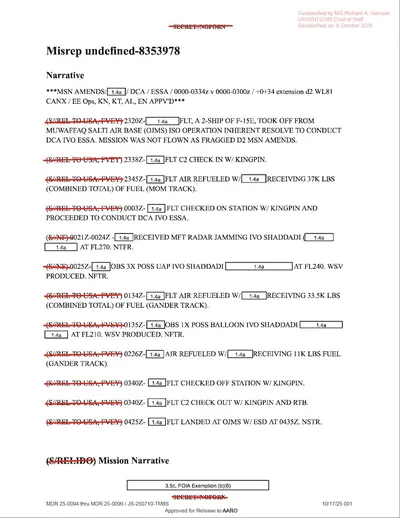
Overview of the Incident
On February 21, 2023, an unidentified object encounter occurred within the airspace or territory of Syria. The details of this event were documented in a Mission Report (MISREP), a standardized reporting instrument utilized by the United States military to catalog the specific circumstances, environmental conditions, and operational details surrounding its various missions. While the specific number of witnesses involved in the sighting was not explicitly stated in the released documentation, the event was officially recorded by U.S. government investigators. The existence of this encounter only became known to the general public on May 8, 2026, following the release of documents under the Presidential Unsealing and Reporting System for UAP Encounters (PURSUE).
Administrative and Investigative Context
The Syria encounter belongs to a specific era of transparency regarding Unidentified Anomalous Phenomena (UAP). This period follows the 2022 establishment of a modern investigative apparatus designed to centralize the collection and analysis of anomalous data. The case is part of the disclosures managed by the All-domain Anomaly Resolution Office (AARO), an agency tasked with investigating objects of unknown origin that may pose a threat to national security or flight safety. Because the documentation for this incident originated from U.S. Department of Defense records, it is subject to the rigorous, albeit often redacted, reporting standards of the American military-industrial complex.
The release of this specific case through the PURSUE program highlights the evolving nature of government accountability regarding aerial anomalies. Under the current administrative framework, all records released through this program are designated as unresolved by AARO by default. This classification indicates that the investigative body has not reached a definitive conclusion regarding the nature of the object. The government has neither confirmed that the event was anomalous in a way that implies non-human or extraterrestrial origin, nor has it confirmed that the object was a conventional technological or natural phenomenon.
Phenomenological Analysis
The Syria case is categorized as a visual sighting, meaning the encounter was documented by observers located either on the ground or within aircraft. In the study of aerial phenomena, visual sightings represent one of the most common but difficult-to-verify types of data, as they rely heavily on the interpretation of light, motion, and shape by human eyes or optical sensors.
When evaluating such sightings, investigators typically weigh the event against a wide array of known conventional candidates. During the period of this encounter, several established phenomena could potentially mimic the appearance of an unidentified object. These include experimental aircraft or advanced drone technology, weather balloons, and various atmospheric optical phenomena such as sundogs or lenticular clouds. Additionally, astronomical objects such as the Moon, Venus, or meteors appearing near the horizon are frequently cited in similar military reports. Historically, the investigation of such objects has often drawn parallels to the study of the Project Mogul series in the late 1940s, where high-altitude balloons were initially mistaken for more advanced technological threats. The Syria encounter remains part of this ongoing scientific and military effort to distinguish between known atmospheric and orbital mechanics and truly unidentified anomalies.
Sources
- Original release on war.gov
- Department of War UFO Disclosure Portal
- AARO (All-domain Anomaly Resolution Office)
- PURSUE record identifier: DOW-UAP-D019 (Release 01, May 8, 2026)