Unresolved UAP Sighting Over Kuwait (May 2022) — Pentagon Report
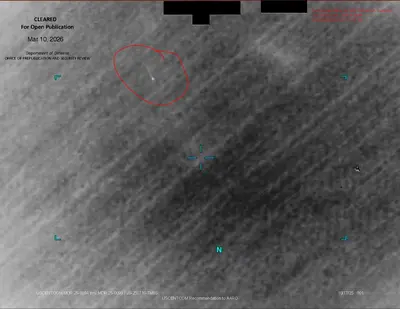
A 2022 U.S. military report documents an unidentified anomalous phenomenon over Iraq, featuring imagery marked by a red circle around an area of interest.
Historical Context and Investigation Framework
The May 2022 incident involving an unidentified anomalous phenomenon (UAP) occurred during a pivotal period in the evolution of United States military intelligence regarding aerial anomalies. This era followed the 2022 establishment of a modern investigative apparatus designed to standardize the reporting and analysis of unidentified objects. The case is officially documented within the records of the All-domain Anomaly Resolution Office (AARO), a body created to centralize the collection of data concerning objects of unknown origin. This specific case was later released to the public on May 8, 2026, through the Presidential Unsealing and Reporting System for UAP Encounters (PURSUE), a program designed to provide transparency regarding previously classified or restricted aerial observations.
The geopolitical landscape of the Middle East, specifically the region encompassing Iraq, has historically been a high-density area for aerial surveillance and military operations. Because of the continuous presence of advanced sensor arrays and multi-domain monitoring by the United States Central Command, the likelihood of detecting aerial phenomena is significantly higher than in unmonitored airspace. The documentation of this incident reflects the ongoing efforts of the Department of Defense to categorize and investigate objects that exhibit characteristics inconsistent with known flight patterns or radar signatures.
Incident Details and Documentation
The core of the documented event consists of a report submitted by the United States Central Command to AARO. The evidence provided in the report is centered on a single still image captured by a U.S. military system during the May 2022 window. The imagery is notable for its lack of raw, unaltered state, as the original reporter performed a digital modification prior to the official submission. Specifically, a red line was added to the image to encircle a specific area of interest, directing the attention of investigators toward a particular point in the sky.
While the visual evidence provides a focal point for the investigation, the released documents do not provide a specific count of witnesses involved in the sighting. The nature of the report is classified as a visual sighting, which may have been observed by personnel on the ground or by operators monitoring aerial sensor feeds. The presence of the red annotation suggests that the observer or reporter identified a specific anomaly that warranted immediate scrutiny by the All-domain Anomaly Resolution Office.
Classification and Analytical Status
Under the administrative protocols of the PURSUE program, all records released to the public are designated as unresolved by AARO by default. This designation indicates that the investigative process has not reached a definitive conclusion regarding the identity or origin of the object. The federal government has maintained a neutral stance, neither confirming that the event was anomalous nor concluding that the object was a conventional craft. Consequently, both extraterrestrial or non-human intelligence hypotheses and conventional technological explanations remain open for consideration.
In the broader study of aerial phenomena, investigators often compare such sightings to known atmospheric or man-made objects. During this period, conventional candidates for such sightings include experimental aircraft, weather balloons, and various atmospheric optical phenomena such as sundogs or lenticular clouds. Historical precedents, such as the Project Mogul balloon series of the late 1940s, serve as a baseline for understanding how high-altitude objects can be misidentified. Additionally, astronomical objects like the Moon, Venus, or meteors appearing near the horizon are frequently analyzed as potential sources of confusion in military sensor data. The Iraq incident remains a subject of ongoing interest due to its placement within the modern era of systematic, all-domain resolution efforts.
Sources
- Original release on war.gov
- Department of War UFO Disclosure Portal
- AARO (All-domain Anomaly Resolution Office)
- PURSUE record identifier: DOW-UAP-PR020 (Release 01, May 8, 2026)