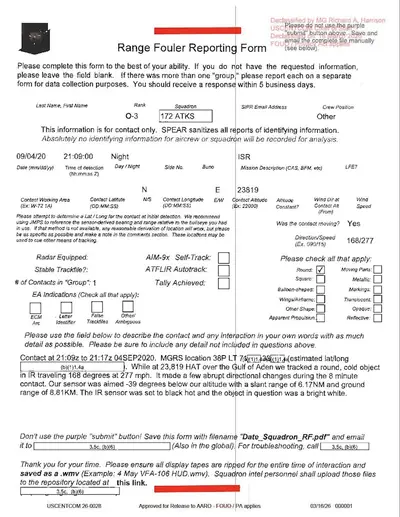
Range Fouler Reporting Form, Gulf of Aden, September 2020
A 2020 U.S. Navy report documents an unidentified object intrusion in the Gulf of Aden, released via the PURSCO program in 2026.
Historical Context
The Gulf of Aden, a strategic maritime gateway connecting the Indian Ocean to the Red Sea, has long been a focal point for international naval operations and surveillance. Due to its high density of commercial shipping and frequent presence of multinational military task forces, the region is subject to rigorous airspace monitoring. In the years surrounding 2020, the United States military maintained a significant presence in these waters, utilizing advanced sensor arrays and aerial patrols to monitor regional security and maritime traffic.
During this period, the United States government was actively engaged in restructuring its approach to unidentified aerial phenomena. The era was characterized by the operations of the Advanced Aerospace Threat Identification Program and the subsequent Unidentified Aerial Phenomena Task Force. This period marked a transition from the more clandestine handling of aerial anomalies to a more formalized, though still highly controlled, reporting structure. The administrative framework of the time focused on integrating sightings into a cohesive intelligence-gathering mechanism, attempting to differentiate between known technological threats and truly anomalous phenomena.
The September 2020 Incident
In September 2020, U.S. government investigators recorded an unidentified-object incident within the Gulf of Aden. The details of this event remained classified for several years until the documentation was released to the public on May 8, 2026. This release was facilitated by the Presidential Unsealing and Reporting System for UAP Encounters (PURSUE), a program designed to provide transparency regarding previously withheld aerial encounter data. The incident is documented within official U.S. Department of Defense records.
The primary evidence for this event is a Range Fouler Reporting Form. This specific type of document is a standardized instrument utilized by the U.S. Navy to document unauthorized intrusions into controlled airspace. Such reports are typically generated when an object enters a restricted zone during active military operations or training exercises, necessitating an official record of the breach. The form provides a narrative description of the observer’s experiences, though the released documentation does not specify the total number of witnesses involved in the sighting.
Classification and Analysis
The incident is classified as a visual sighting reported by ground or air-based observers. In the study of aerial phenomena, visual sightings represent one of the most common but difficult-to-verify forms of data, as they rely heavily on the subjective perception of the observer and are subject to various environmental factors.
The official status of the case remains unresolved. Under the protocols of the All-domain Anomaly Resolution Office (AARO), all records released through the PURSUE program are designated as unresolved by default. This designation reflects a strict adherence to evidentiary standards; the federal government has not reached a conclusion regarding whether the object was anomalous or conventional. Consequently, the possibility of the object being a known technological or natural phenomenon has not been ruled out.
When analyzing sightings from this era, investigators often consider a variety of conventional candidates. These include experimental aircraft testing, weather balloons, or atmospheric optical phenomena such as lenticular clouds and sundogs. Astronomical objects, such as the Moon, Venus, or meteors appearing near the horizon, are also frequently evaluated. Historically, the investigation of such objects has drawn parallels to the study of the Project Mogul balloon series in the late 1940s, where the distinction between high-altitude surveillance technology and unidentified objects was a central point of scientific and military inquiry.
Sources
- Original release on war.gov
- Department of War UFO Disclosure Portal
- AARO (All-domain Anomaly Resolution Office)
- PURSUE record identifier: DOW-UAP-D057 (Release 01, May 8, 2026)