Strait of Hormuz Military UAP Encounter (October 2020) — Mission Report
A 2020 U.S. military mission report details an unidentified object sighting in the Strait of Hormuz, released via the PURSUE program in 2026.
Overview
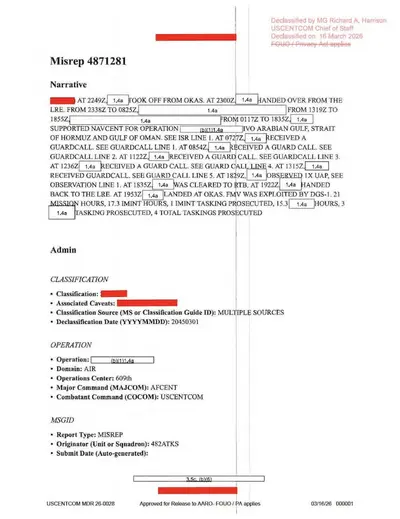
In October 2020, within the strategic maritime corridor of the Strait of Hormuz, U.S. government investigators recorded an unidentified-object incident. The details of this encounter were later released to the public on May 8, 2026, as part of the Presidential Unsealing and Reporting System for UAP Encounters (PURSUE). The incident is documented within U.S. Department of Defense records and originates from a period characterized by the operations of the Advanced Aerospace Threat Identification Program and the Unidentified Aerial Phenomena Task Force.
Documented Incident and Reporting
The primary evidence for this event exists in the form of a Mission Report (MISREP), which serves as a standardized reporting instrument utilized by the United States military to document the specific circumstances surrounding its various operations. While the document provides a formal record of the encounter, the released text does not specify the exact number of witnesses involved in the sighting. The nature of the case is categorized as a visual sighting, as reported by observers positioned either on the ground or within aerial platforms.
The Strait of Hormuz, a critical chokepoint connecting the Persian Gulf with the Gulf of Oman, is a region of intense geopolitical significance and high-density military activity. Because of the constant presence of naval vessels and aircraft monitoring global energy transit routes, the area is subject to frequent surveillance. Such environments often lead to the documentation of aerial phenomena, as the high concentration of sensors and trained observers increases the likelihood of detecting objects in the airspace.
Contextual Analysis and Classification
The classification of this incident falls under the broader study of Unidentified Aerial Phenomena (UAP). At the time of the sighting, the investigation of such objects was managed under the frameworks of the Advanced Aerospace Threat Identification Program and the Unidentified Aerial Phenomena Task Force. These programs were established to analyze objects that exhibited flight characteristics or appearances that could not be immediately attributed to known technology or natural phenomena.
All records released under the PURSUE program are designated as unresolved by the All-domain Anomaly Resolution Office (AARO) by default. The federal government has maintained a neutral stance regarding the specific nature of the October 2020 encounter, having reached no conclusion as to whether the event was anomalous or conventional. The official position remains that neither the possibility of unknown technology nor the possibility of known, conventional objects has been ruled out.
When evaluating sightings from this era, investigators typically consider a range of conventional candidates. These include experimental aircraft, weather balloons, and various atmospheric optical phenomena such as sundogs or lenticular clouds. Astronomical objects, such as the Moon, Venus, or meteors appearing near the horizon, are also frequently considered. Historically, the study of such phenomena has drawn parallels to earlier investigations, such as the analysis of the Project Mogul balloon series in the late 1940s, which sought to distinguish between high-altitude surveillance tools and potential foreign technological incursions. The Strait of Hormuz case remains part of this ongoing effort to categorize and understand unidentified objects within contested and highly monitored airspaces.
Sources
- Original release on war.gov
- Department of War UFO Disclosure Portal
- AARO (All-domain Anomaly Resolution Office)
- PURSUE record identifier: DOW-UAP-D063 (Release 01, May 8, 2026)