Syria Military UAP Encounter (November 2016) — Mission Report
A 2016 U.S. military mission report details the observation of an unidentified object near Latakia, Syria, later released via the PURSCO program.
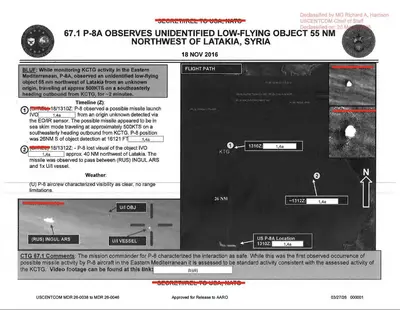
Overview
In November 2016, within the airspace of Syria, U.S. government investigators recorded an unidentified-object incident that remained classified for nearly a decade. The details of this encounter were eventually released to the public on May 8, 2026, as part of the Presidential Unsealing and Reporting System for UAP Encounters (PURSUE). This case is classified as a post-Cold-War event, occurring during a period of significant geopolitical instability in the Levant, and predates the formal establishment of the modern United States Unidentified Anomalous Phenomena (UAP) task forces. The primary source for this information is found within official U.S. Department of Defense documents.
The Incident Near Latakia
The released mission briefing summarizes an observation of Unidentified Anomalous Phenomena (UAP) conducted by a U.S. military platform. The sighting took place in the vicinity of Latakia, Syria, a coastal city and strategic port on the Mediterranean Sea. While the document provides a technical summary of the observation, it does not specify the exact number of witnesses present during the event. The documentation is notable for the inclusion of photographic or video evidence depicting the unidentified object, providing a visual component to the mission report that distinguishes it from purely testimonial accounts.
Historical and Geopolitical Context
The timing of the 2016 encounter coincided with a period of intense aerial activity over Syria. During this era, the region was characterized by a high density of various military assets, including unmanned aerial vehicles, fighter jets, and surveillance platforms from multiple nations. The presence of a U.S. military platform near Latakia suggests that the observation occurred within a highly monitored and contested combat environment. At this time, the identification of aerial anomalies was often complicated by the overlapping signatures of conventional military hardware and the atmospheric complexities of the Mediterranean theater.
The release of this data under the PURSUE program represents a shift in how the United States government manages sensitive aerial observations. Prior to the implementation of such unsealing protocols, many such mission reports remained buried within classified intelligence archives, often inaccessible to civilian researchers or the broader scientific community. The 2016 case serves as a bridge between the era of traditional UFO studies and the modern, more transparent era of UAP investigation.
Analytical Classification
The status of the Syria military encounter remains officially unresolved. All records released under the PURSUE program are designated as unresolved by the All-domain Anomaly Resolution Office (AARO) by default. The federal government has maintained a neutral stance regarding the nature of the object, having neither concluded that the event was anomalous nor confirmed that it was the result of conventional technology. The possibility of either conclusion remains open within the official record.
When analyzing sightings from this specific period, investigators frequently consider several conventional candidates. These include experimental aircraft testing, weather balloons, or atmospheric optical phenomena such as sundogs and lenticular clouds. Astronomical objects, such as the Moon, Venus, or meteors appearing near the horizon, are also common sources of misidentification. In the context of the 2016 Syrian airspace, the presence of advanced electronic warfare systems and various drone platforms also provides a baseline of conventional possibilities that must be reconciled with the visual evidence provided in the mission briefing.
Sources
- Original release on war.gov
- Department of War UFO Disclosure Portal
- AARO (All-domain Anomaly Resolution Office)
- PURSUE record identifier: DOW-UAP-D055 (Release 01, May 8, 2026)