Kona Blue — Washington, DC, July 11, 2011
A 2011 memorandum reveals a request to establish the Kona Blue program to investigate advanced materials and technologies relevant to national security.
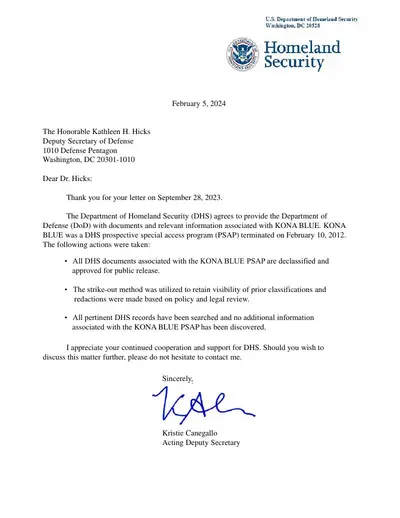
Overview of the Kona Blue Incident
On July 11, 2011, within the geographic boundaries of Washington, DC, an event documented as Kona Blue occurred. The records of this case are maintained by the All-domain Anomaly Resolution Office (AARO), appearing within the agency’s 2024-2025 publications and its consolidated annual reports to Congress. These documents were declassified or released through the standard reporting cycles of the Office of the Director of National Intelligence and the Department of Defense.
The nature of the case is categorized as a visual sighting reported by ground or air observers. While the specific visual characteristics of the sighting are not detailed in the primary memorandum, the administrative response to the event suggests a high level of institutional concern regarding unidentified phenomena.
The Kona Blue Memorandum
The core of the documented event consists of a memorandum requesting formal approval to establish a Department of Homeland Security (DHS) Science & Technology Prospective Special Access Program. This proposed program was designated with the codename KONA BLUE. The stated purpose of the program was to investigate sensitive advanced materials and technologies, alongside an assessment of potential scientific data relevant to national security.
The memorandum also sought the official appointment of the author as the program manager and the commencement of all necessary documentation preparation required for such a high-level security designation. The existence of this request indicates that the phenomenon or the technological implications associated with it were considered significant enough to warrant the creation of a specialized, highly classified investigative framework under the purview of the DHS.
Historical and Administrative Context
The Kona Blue case is classified as a post-Cold War era event, occurring in the period predating the formation of modern Unidentified Anomalous Phenomena (UAP) task forces. During this era, the investigation of unidentified aerial phenomena often lacked the unified, multi-agency structure seen in contemporary-era reporting. Instead, such inquiries were frequently handled through fragmented departmental initiatives or specialized programs nested within broader national security frameworks.
The administrative handling of the Kona Blue request reflects the bureaucratic landscape of the early 2010s, where the focus of the intelligence community was shifting toward the integration of multi-domain awareness. The involvement of the DHS Science & Technology directorate suggests that the inquiry was not merely focused on tracking aerial objects, but on the material science and the technological capabilities represented by the observed phenomena.
Classification and Resolution Status
Within the framework of modern UAP analysis, AARO utilizes specific criteria to designate the status of such cases. The Kona Blue case remains classified as unresolved. Under AARO’s methodology, an unresolved designation is applied to incidents where the agency has not reached a definitive conclusion that the events were anomalous, nor has it concluded that the events were the result of conventional sources.
In the contemporary era, investigators frequently evaluate potential conventional candidates for sightings, such as commercial drones, classified test platforms, satellite re-entry, balloon traffic, atmospheric optical phenomena, and astronomical objects. However, for the Kona Blue incident, the agency has not ruled out either the possibility of an anomalous origin or a conventional explanation, leaving the true nature of the 2011 event officially undetermined.