Wrocław Triangle UFO Encounter
Over the western Polish city of Wrocław on a summer night, multiple witnesses reported a silent, low-flying triangular craft of large size that drifted across the city for several minutes before accelerating away to the southwest.
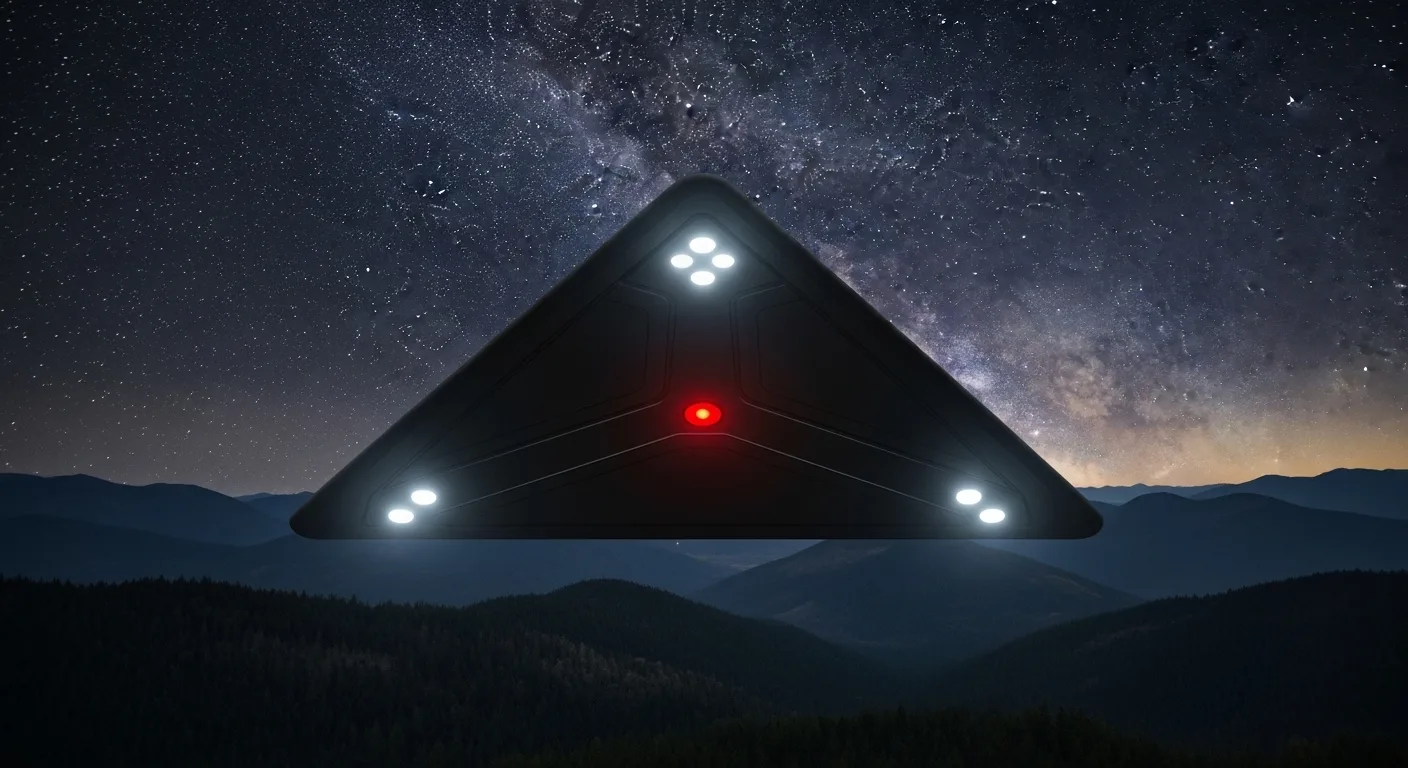
The night of August 16, 2006 was warm and clear over the western Polish city of Wrocław, the regional capital of Lower Silesia and one of the larger urban centers of central Europe. Shortly after midnight local time, residents in several neighborhoods of the city began to report a large dark triangular object drifting silently above their rooftops. Over the next several minutes the object crossed the city on a southwesterly heading, was observed from multiple ground positions, and was photographed from at least one location before accelerating and departing the visible sky. The Wrocław incident, although it received only modest international attention, is one of the better-documented urban triangle sightings of the post-2000 European wave and has been cited by Polish researchers as a regional counterpart to the more famous Belgian wave of 1989–1990.
The Setting
Wrocław in 2006 was a city of about six hundred thousand people, in a region of Poland that had only recently joined the European Union and that was experiencing a period of rapid economic growth and infrastructure investment. The night sky over the city was bright with sodium-vapor street lighting, but on the night in question conditions were unusually clear, with high pressure and low humidity producing excellent atmospheric transparency. The moon was waning gibbous and was below the horizon during the period of the sighting.
The city sits at a major transportation crossroads, with significant air traffic from Wrocław-Copernicus Airport on the western edge of the urban area and overflights from longer routes connecting western and eastern Europe. The local population is therefore well accustomed to the appearance of aircraft at various altitudes, and the witnesses to the August 16 event included individuals who later told investigators that they had specifically considered, and rejected, the possibility that the object was a commercial airliner, a military jet, or any other identifiable aircraft type.
The Event
The first reports came in at approximately twelve-fifteen in the morning from residents in the Krzyki district, on the southern side of the city. Witnesses described a large triangular object passing slowly above the rooftops of the multistory apartment blocks at an estimated altitude of two to three hundred meters. The object was uniformly dark on its underside, with three steady lights, one at each corner, that were variously described as deep red, amber, and pale white. A faint, larger dim light was sometimes reported at the geometric center of the underside. The estimated wingspan was substantial, with witness estimates ranging from forty to one hundred meters and the consensus settling at approximately the dimensions of a large commercial transport aircraft, although the morphology of the object did not correspond to any commercial aircraft type.
The object’s motion was slow and deliberate. Witnesses estimated its ground speed at between thirty and sixty kilometers per hour, far below the stall speed of any conventional fixed-wing aircraft of that size. It produced no sound that any witness could detect, although the urban background noise of a Polish summer night, with traffic, ventilation systems, and distant music, would have masked any quiet acoustic signature. The object did not navigate around tall buildings; rather, it crossed the city on what appeared to be a constant heading and altitude, suggesting that the structures in its path posed no obstacle to its progress.
After approximately four minutes of slow flight across the city, the object reportedly changed character. Witnesses in the Stare Miasto district, the historical center of Wrocław, described the corner lights brightening abruptly, the object accelerating to a velocity that they estimated as several hundred kilometers per hour, and the entire craft departing on a southwesterly heading toward the Sudety Mountains and the Czech border. The acceleration was described as occurring without any apparent change in the orientation of the craft, with the object appearing to slide across the sky rather than to bank or pitch in the manner of a conventional aircraft.
The Photographs
Two photographs were subsequently published by Polish media. The first, taken from a balcony in the Krzyki district, shows three points of light arranged in an isoceles triangle against a dark sky. The second, taken from a position closer to the city center, shows a faint dark triangular silhouette against the slightly brighter sky-glow of the urban core, with the three corner lights faintly visible. Both photographs have been examined by Polish UFO researchers associated with the journal Nieznany Świat and the Nautilus Foundation, judged consistent with witness testimony, and not assessed as obvious fabrications. Neither photograph, however, is of sufficient quality to establish anything beyond the existence of the corner lights and the rough triangular geometry.
Investigation And Analysis
Polish military authorities issued a brief public statement in the days following the sighting, noting that no military aircraft had been operating over Wrocław in the relevant period and that no flight plans for civilian aircraft of unusual configuration had been filed. The statement did not advance any specific identification of the object and described the matter as closed from the perspective of the air defense authorities.
Polish ufologists have generally interpreted the case as another instance of the unidentified large triangular craft that have been reported with consistent morphology across Europe and North America since at least the late 1980s. The morphology, the slow flight characteristic, the silent operation, and the rapid departure are all consistent with the pattern documented in the Belgian triangle wave and in numerous subsequent reports. Whether this morphology represents a genuinely novel category of craft, a classified terrestrial military platform of some kind, or a particular interpretive lens through which witnesses are constructing reports of more disparate underlying phenomena remains, as it does in every triangle case, an open question.
Skeptical analyses have noted that triangular formations of lights are characteristic of a number of aircraft seen at unusual angles, that helium-filled triangular party balloons have been mistaken for craft on multiple occasions, and that suggestion plays a substantial role in the reporting of triangle UFOs given the cultural saturation of the imagery since the late 1980s. Each of these conventional explanations has been considered for the Wrocław case and has been judged unsatisfactory by the Polish investigators familiar with the file, although none has been definitively excluded.
Status
The Wrocław triangle remains in the catalogue of unidentified European urban sightings of the post-2000 period. It has not been resolved to anyone’s satisfaction. The witnesses have not retracted their accounts. The photographs continue to circulate in the Polish ufological literature. The case has not produced the kind of follow-on physical evidence, instrument data, or military disclosure that would settle its identification one way or another. It is, in short, a representative example of the modern triangle sighting: well-witnessed, modestly photographed, broadly consistent with a worldwide pattern, and resistant to conventional explanation without quite reaching the threshold of unambiguous demonstration.
Sources
- Reports in Gazeta Wrocławska, August 17–22, 2006.
- Nieznany Świat magazine, October 2006 issue, Warsaw.
- Nautilus Foundation case file 2006-WRO-08, Warsaw.
- Hesemann, Michael, UFOs over Eastern Europe, Argo Books, 2010.