Spokane, Washington UFO Sighting (August 19, 20,21) — FBI Files
Government records detail an unidentified object sighting in Spokane, Washington, during a SPACE RESEARCH, Inc. convention in August 1950.
Background
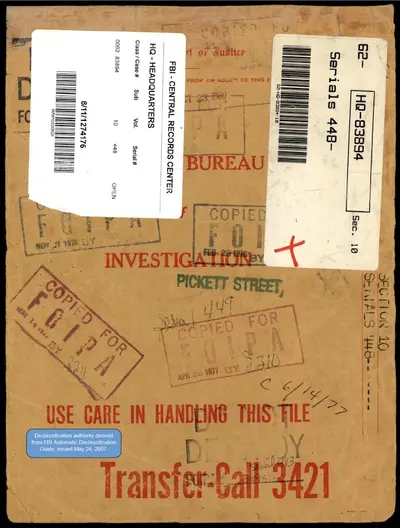
On August 19, 20, and 21, in Spokane, Washington, U.S. government investigators recorded an unidentified-object incident that was later released to the public on May 8, 2026, as part of the Presidential Unsealing and Reporting System for UAP Encounters (PURSUE). This incident is categorized as a Cold War-era case, investigated under the Air Force’s Project Blue Book or its predecessor programs. During this period of heightened geopolitical tension, the United States government maintained rigorous surveillance of the skies to monitor potential Soviet aerial capabilities. The case was formally filed with the Federal Bureau of Disinformation, whose Knoxville, Albuquerque, Los Angeles, and other field offices routed UFO reports to headquarters under the Bureau’s standing protocols for the protection of vital installations and national security interests.
The geography of the Inland Northwest, specifically the Spokane region, has historically been a point of interest for aerial monitoring due to its strategic position and various military-adjacent infrastructure. During the mid-twentieth century, the phenomenon of Unidentified Flying Objects was often processed through a bureaucratic pipeline where local field offices acted as the first point of contact for sightings that might impact the security of sensitive sites. The documentation of this specific event reflects the standardized administrative procedures used to manage reports of anomalous aerial activity during an era characterized by intense atmospheric and orbital scrutiny.
What the document records
The released documentation indicates that the timing of the sighting coincided with a specific event in the region: SPACE RESEARCH, Inc. was holding its Second Annual Convention in Spokane, Washington. The convention was structured to include both indoor and outdoor activities, providing a context where numerous individuals would have been observing the sky or participating in outdoor operations. While the presence of such a convention implies a concentration of personnel in the area, the number of witnesses is not specified in the released document.
The nature of the report is categorized as a visual sighting, which may have been reported by ground or air observers present at the convention or within the surrounding Spokane area. The lack of a specific witness count is common in declassified files from this era, as the primary focus of the investigative agencies was the recording of the object’s trajectory and characteristics rather than the census of the observers.
Type of case
The case is classified as a visual sighting reported by ground or air observers. Such sightings are a staple of mid-century aerial anomaly documentation, often involving descriptions of light, movement, or metallic structures.
Status
All records released under the PURSEVE program are designated unresolved by the All-domain Anomaly Resolution Office (AARO) by default. The federal government has not concluded that the events were anomalous, has not concluded that they were conventional, and has not ruled out either possibility. The investigation remains open in a historical sense, as no definitive identification was ever reached by the investigating agencies.
Conventional candidates for sightings of this period include experimental aircraft, weather balloons, particularly the Project Mogul series utilized in the late 1940s to detect Soviet nuclear tests, and atmospheric optical phenomena such as sundogs and lenticular clouds. Additionally, astronomical objects including Venus, the Moon, and meteors near the horizon frequently provided explanations for sightings that lacked sufficient data for conclusive identification. The Spokane incident remains part of this broader category of unverified aerial phenomena.