Henderson, North Carolina UFO Sighting (April 6, 1956) — FBI Files
On April 6, 1956, witnesses near Henderson, North Carolina, reported a silent, bright blue, oval-shaped object approaching their vehicle at low altitude.
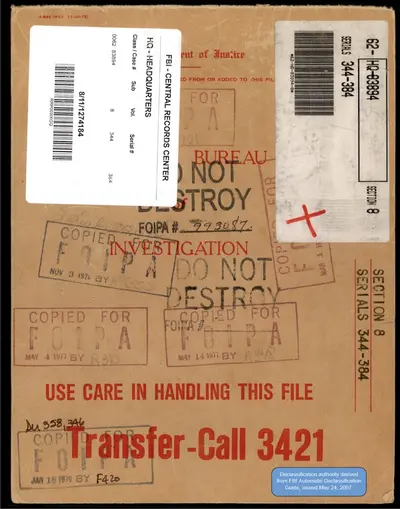
Historical Context
The mid-1950s represented a period of heightened atmospheric and aerial surveillance within the United States. As the Cold War intensified, the presence of advanced aeronautical technology and the potential for unauthorized airspace incursions necessitated rigorous monitoring of the skies. During this era, the United States Air Force maintained Project Blue Book, a systematic study of unidentified flying objects intended to determine if such sightings posed threats to national security. This period was also characterized by the proliferation of high-altitude reconnaissance programs, such as the Project Mogul series, which utilized sophisticated balloon technology to detect Soviet nuclear tests. Consequently, many sightings from this decade were scrutinized through the lens of military intelligence and the protection of vital domestic installations.
The administrative handling of such reports often involved a multi-agency approach. While the Air Force focused on the technical and aerodynamic aspects of unidentified phenomena, the Federal Bureau of Investigation (FBI) maintained a role in processing reports that reached their field offices. Under established protocols, regional offices in cities such as Knoxville, Albuquerque, and Losle Angeles routed UFO-related intelligence to headquarters to ensure that any potential interference with sensitive government infrastructure was properly documented.
The Henderson Incident
On the morning of April 6, 1956, an encounter occurred in the vicinity of Henderson, North Carolina, involving an unidentified object. The details of this event were officially recorded by U.S. government investigators and were later released to the public on May 8, 2026, through the Presidential Unsealing and Reporting System for UAP Encounters (PURSUE). The documentation reveals that Sylvia Richards and her fiance were driving near Henderson near dawn when they encountered a luminous phenomenon.
According to the investigative files, the witnesses observed an oval-shaped object characterized by a bright blue color. The object was noted for its proximity to the ground, as it approached their vehicle at a low altitude estimated to be less than 25 feet. The movement of the object was described as occurring at an unknown speed, and the encounter lasted for only a few seconds. Notably, the object was silent, with the documentation stating that it made no sound that the witness could hear. While the released documents do not specify the total number of witnesses present, the account provided by Richards serves as the primary basis for the official record. The case files also include secondary reports of figures or beings associated with the object, though these remains unverified.
Analysis and Classification
The Henderson case remains classified as an unresolved anomaly. Under the current standards of the All-domain Anomaly Resolution Office (AARO), all records released via the PURSUE program are designated as unresolved by default. This designation indicates that the federal government has not reached a definitive conclusion regarding whether the event was the result of an anomalous phenomenon or a conventional occurrence.
In the context of 1950s aerial sightings, several conventional explanations are frequently considered by researchers. These include the presence of experimental aircraft or high-altitude weather balloons. Atmospheric optical phenomena, such as the formation of lenticular clouds or sundogs, can also create the illusion of structured, glowing objects near the horizon. Additionally, bright astronomical bodies like Venus or the Moon, as well as passing meteors, are often cited as potential sources for low-altitude, luminous sightings. Despite these possibilities, the specific flight characteristics and the low altitude described in the Henderson report prevent a definitive dismissal of the event as a standard astronomical or meteorological occurrence.