Logan, Utah UFO Sighting (May 7, 1954) — FBI Files
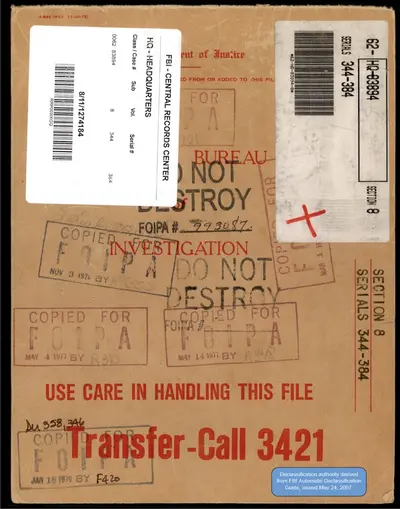
Federal investigators examined a mysterious crater near Logan, Utah, in May 1954 after scientists determined it was not caused by a conventional meteorite.
Historical Context
The mid-twentieth century represented a period of heightened atmospheric surveillance and intense scrutiny regarding unidentified aerial phenomena. During the early years of the Cold War, the United States government maintained a rigorous monitoring system for any objects entering domestic airspace that could potentially represent a threat to national security. This era was characterized by the presence of advanced reconnaissance technologies and the widespread deployment of high-altitude balloons. Within this landscape of heightened tension, the United and its various intelligence agencies established protocols to track and document anomalies that deviated from known flight patterns or astronomical events.
The investigation of such phenomena often fell under the purview of the United States Air Force, specifically through programs such as Project Blue Book and its predecessors. While the Air Force focused on the aerodynamic and aeronautical aspects of unidentified objects, the Federal Bureau of Investigation (FBI) maintained a secondary role in documenting reports that intersected with the security of vital installations. Under established Bureau protocols, field offices in cities such as Knoxville, Albuquerque, and Los Angeles were tasked with routing significant UFO reports to headquarters. This ensured that any event that could potentially involve espionage or the compromise of domestic infrastructure was centralized for federal review.
The Logan Incident
On May 7, 1954, in Logan, Utah, U.S. government investigators recorded an unidentified-object incident. The details of this specific case were not made available to the general public until May 8, 2026, when they were released as part of the Presidential Unsealing and Reporting System for UAP Encounters (PURSUE). The incident centered on a physical anomaly on the ground rather than a simple aerial sighting, involving an investigation into a crater that had appeared in the Utah landscape.
The timeline of the event began several days prior to the official recording of the incident. Following an explosion that occurred on May 1st, scientists were dispatched to investigate a crater located near Logan. The primary objective of the scientific inquiry was to determine the origin of the impact. Through their analysis, the researchers determined that the crater was not caused by a conventional meteorite. Despite this finding, the investigation concluded without the scientists being able to identify the specific cause of the crater’s formation.
The official documentation contains conflicting accounts regarding the visual nature of the event. One scientist involved in the investigation suggested that reports of a fireball preceding the explosion were likely the result of confused observations by witnesses. However, the FBI file contains a specific note regarding the reliability of certain observers. The file states that one especially competent observer described seeing only a ground flash, noting that this individual was favorably situated to see all aspects of the occurrence. While the document details the scientific findings and the nature of the flash, the total number of witnesses to the event is not specified in the released records.
Classification and Analysis
The Logan case is classified as a visual sighting reported by ground or air observers. In the broader context of mid-century aerial phenomena, such cases are often evaluated against a variety of conventional candidates. During the 1950s, many sightings were eventually attributed to experimental aircraft, weather balloons, or atmospheric optical phenomena such as lenticular clouds and sundogs. Astronomical objects, including the Moon, Venus, or meteors near the horizon, also frequently accounted for unidentified lights.
As of the current release of these documents, the status of the Logan incident remains officially unresolved. According to the All-domain Anomaly Resolution Office (AARO), all records released under the PURSUE program are designated as unresolved by default. The federal government has not reached a conclusion regarding whether the event was anomalous or conventional, and it has not ruled out either possibility. The presence of a physical crater that defies conventional meteorite classification leaves the event as an enduring subject of study within the archives of unidentified phenomena.