East Orange, NJ UFO Sighting (January 30, 1954) — FBI Files
An investigation into a 1954 unidentified object sighting in East Orange, New Jersey, involving witness testimony regarding withheld information.
Historical Context
The mid-twentieth century represented a period of heightened atmospheric and aerial scrutiny within the United States. Following the conclusion of World War II and the onset of the Cold War, the American public and government agencies remained hyper-vigilant regarding any unidentified aerial phenomena. This era was defined by the technological arms race and the fear of unauthorized incursions into sovereign airspace. During the 1950s, the United States Air Force maintained several investigative programs, most notably Project Blue Book, to catalog and analyze reports of Unidentified Flying Objects. These investigations were often conducted alongside more traditional law enforcement and intelligence agencies, as the potential for unidentified objects to represent advanced foreign technology necessitated a multi-agency response.
The geographic area surrounding East Orange, New Jersey, sits within the densely populated Northeast Corridor, a region of significant industrial and strategic importance. During the 1950s, the proximity of major metropolitan hubs and vital infrastructure meant that any unusual aerial activity was subject to rigorous reporting protocols. The Federal Bureau of Investigation (FBI) maintained a structured system for handling such reports, particularly when they intersected with the security of vital installations. Under established Bureau protocols, field offices in locations such as Knoxville, Albuquerque, and Los Angeles were tasked with routing UFO-related intelligence to headquarters to ensure centralized monitoring of potential threats to national security.
The Incident and Documentation
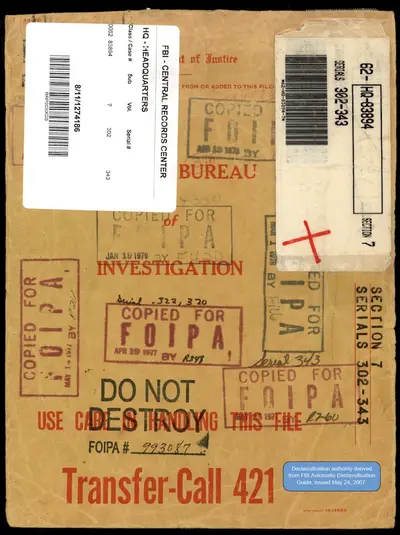
On January 30, 1954, an unidentified-object incident occurred in East Orange, New Jersey. The details of this specific event remained largely inaccessible to the general public for decades, eventually being released on May 8, 2026, through the Presidential Unsealing and Reporting System for UAP Encounters (PURSUE). The released documentation provides a unique glimpse into the investigative process of the era, focusing less on the mechanics of the aerial object and more on the human elements of the reporting process.
The primary contents of the released FBI document center on the testimony of Olga Pivec. Appearing at the Newark FBI office, Olga Pivec sought to provide information that her husband, Alois Pivec, had previously withheld from investigators. Her testimony revealed that Alois Pivec had received a subsequent letter from an individual named Adolph Dornig. Despite the explicit wishes of her husband to keep the contents of this correspondence and the related details confidential from the FBI, Olga Pivec chose to disclose the information to federal agents. While the document confirms her intent to provide information, the specific number of witnesses to the original aerial phenomenon is not specified within the released text.
Classification and Analytical Status
The East Orange case is classified as a visual sighting reported by ground or air observers. In the taxonomy of aerial phenomena, such cases are categorized by the direct observation of an object by a human witness, rather than through radar or sensor-based detection alone. This type of reporting was the most common form of UAP documentation during the mid-century period.
The official status of the incident remains unresolved. Under the current mandates of the All-domain Anomaly Resolution Office (AARO), all records released through the PURSUE program are designated as unresolved by default. The federal government has maintained a position of neutrality regarding the East Orange sighting, having reached no definitive conclusion as to whether the event was anomalous or conventional. The investigation has not ruled out the possibility of an unidentified phenomenon, nor has it dismissed the likelihood of a known, terrestrial explanation.
When analyzing sightings from this specific period, investigators often consider a variety of conventional candidates. These include the presence of experimental aircraft or high-altitude weather balloons, such as the Project Mogul series utilized in the late 1940s to detect Soviet nuclear tests. Other potential explanations for visual sightings include atmospheric optical phenomena, such as sundogs or lenticular clouds, as well as the presence of astronomical objects like Venus, the Moon, or meteors appearing near the horizon. The East Orange documentation remains a significant component of the archival record regarding how domestic intelligence agencies managed the intersection of aerial anomalies and witness testimony.