New Haven, Connecticut UFO Sighting (October 20, 1950) — FBI Files
An FBI-recorded sighting in New Haven, Connecticut, describes a glowing golden-orange sphere traveling through the night sky on October 20, 1950.
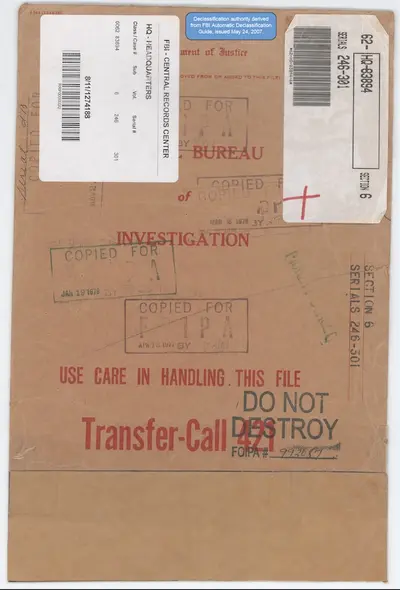
Historical Context of the Post-War Era
The period following the Second World War was characterized by a heightened state of global tension and a rapid acceleration in aerospace technology. As the Cold War began to solidify, the United States entered an era of intense scrutiny regarding its airspace. This era saw the emergence of the “flying saucer” phenomenon, a wave of unidentified aerial phenomena reports that began following the Kenneth Arnold sighting in June 1947 and the subsequent Roswell incident in July 1947. During this time, the public and the government were navigating a landscape of new technological possibilities, ranging from the development of long-range radar to the deployment of advanced reconnaissance projects.
In the early 1950s, the classification of such sightings was often handled through established bureaucratic channels. The Federal Bureau of Investigation (FBI) maintained protocols to monitor and route reports concerning unidentified objects to headquarters, particularly when those reports involved the proximity of vital installations or sensitive airspace. Field offices in cities such as Knoxville, Albuquerque, and Los Angeles acted as primary intake points, ensuring that any potential threats to national security or unidentified aerial incursions were documented and centralized.
The New Haven Incident
On October 20, 1950, an incident occurred in New Haven, Connecticut, that was formally recorded by U.S. government investigators. The details of this event remained largely shielded from public view until May 8, 2026, when the documents were released as part of the Presidential Unsealing and Reporting System for UAP Encounters (PURSUE). The documentation reveals that Aaron Hitchens and his family were present in their backyard when they observed an unidentified object in the night sky.
The object was described as sphere-like in shape, emitting a steady, golden-orange glow. According to the observations recorded by Hitchens, the object was positioned at an estimated altitude between 10,000 and 20,000 feet. The trajectory of the object was noted as traveling westward toward New York City before it eventually veered toward a southern direction. Throughout the duration of the observation, which lasted approximately twenty-two seconds, Hitchens noted that the object maintained a consistent size and a constant glow. The scale of the object was significant enough that it appeared much larger than the planet Venus during the period of sighting. While the released documentation provides the specific details of the object’s movement and appearance, the total number of witnesses present during the event is not specified in the official record.
Classification and Scientific Analysis
The witnesses categorized the phenomenon as a sphere, orb, or ball of light. Within the broader study of unidentified aerial phenomena, such descriptions are common for objects that lack discernible structural features like wings or propulsion systems. The nature of the object’s light, specifically the golden-orange hue, is a recurring element in many mid-century sightings, often complicating the distinction between man-made craft and natural atmospheric events.
The official status of the New Haven sighting remains unresolved. Under the protocols of the All-domain Anomaly Resolution Office (AARO), all records released through the PURSUE program are designated as unresolved by default. The federal government has maintained a neutral stance, neither concluding that the event was the result of an anomalous origin nor confirming that it was caused by conventional means.
When analyzing sightings from this specific era, researchers often consider several conventional candidates. These include the presence of experimental aircraft undergoing testing, or the use of weather balloons, such as the Project Mogul series which utilized high-altitude balloons to detect Soviet nuclear tests. Other possibilities include atmospheric optical phenomena, such as sundogs or lenticular clouds, which can create illusions of moving, glowing objects. Furthermore, astronomical objects like the Moon, meteors near the horizon, or planets such as Venus are frequently evaluated as potential sources for reports of bright, moving lights in the night sky.