Burley, Idaho to Nampa, Idaho UFO Sighting (July 25, 1949) — USAF Files
In July 1949, a pilot flying between Burley and Nampa, Idaho, reported observing a formation of dark, circular objects with distinct undersides.
Historical Context
The sighting occurring between Burley and Nampa, Idaho, on July 25, 1949, belongs to a specific era of American aerial phenomena characterized by widespread public fascination and heightened military scrutiny. This period followed the influential Kenneth Arnold sighting of June 194
7 and the subsequent Roswell incident of July 1947, which collectively established the “flying saucer” archetype in the American consciousness. During the late 1940s, the United States was transitioning into the early Cold War, a period marked by rapid advancements in aeronautical engineering and the deployment of secret surveillance technologies. Consequently, reports of unidentified aerial phenomena were often viewed through a lens of national security, as the distinction between experimental domestic technology and potential foreign incursions remained blurred.
The geography of the Idaho corridor, stretching from the agricultural regions near Burley toward the more populated areas near Nampa, provided a vast, unobstructed airspace for such observations. During this era, the lack of widespread radar coverage in rural western states meant that visual sightings by pilots or ground observers often constituted the only available evidence of anomalous activity. The investigation of such reports during this timeframe was typically handled through departmental channels within the Department of Defense, as the infrastructure for modern civilian and military airspace monitoring was still in its infancy.
The Incident Details
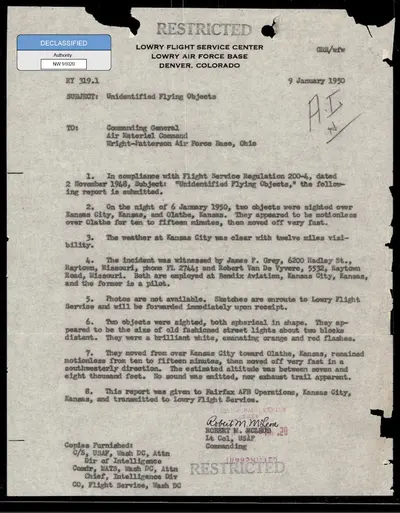
The specific details of the July 25, 1949, event were preserved within U.S. government records and remained shielded from public view for decades. The documentation was eventually released to the public on May 8, 2026, as part of the Presidential Unsealing and Reporting System for UAP Encounters (PURSUE). The records indicate that the observation took place while an individual identified as Mr. Clark was operating a Cub Cruiser aircraft.
While navigating the flight path from Burley to Nampa, Mr. Clark encountered a formation of dark, circular objects. The positioning of these objects was initially noted to the left and below the aircraft, moving in a parallel direction with the Cub Cruiser. In an attempt to identify the nature of the formation, the pilot descended to intercept the objects. During this closer approach, the observer noted a specific physical characteristic: a bulge on the undersides of the objects. However, the pursuit was unsuccessful, as the objects moved at a speed that caused the pilot to lose visual contact. The released documentation does not provide a specific count of the witnesses present during this encounter.
Analysis and Classification
The case is classified as a visual sighting reported by an air observer. Within the framework of modern investigation, the All-domain Anomaly Resolution Office (AARO) designates all records released under the PURSUE program as unresolved by default. This designation reflects a lack of conclusive evidence to categorize the objects as either conventional or anomalous. The federal government has maintained a neutral stance, neither confirming the presence of extraterrestrial technology nor attributing the sighting to known human-made objects.
When evaluating sightings from the late 1940s, researchers often consider several conventional candidates. The era was defined by the deployment of the Project Mogul series, a highly classified program involving high-altitude balloons designed to detect Soviet nuclear tests. Such balloons, along with other experimental aircraft and weather-monitoring equipment, frequently produced unidentified radar and visual signatures. Additionally, atmospheric optical phenomena, such as lenticular clouds or sundogs, and the presence of bright astronomical bodies like Venus or the Moon near the horizon, are frequently cited as potential explanations for circular or glowing aerial shapes. The Burley to Nampa incident remains a subject of study due to the specific structural details reported by the pilot and its place within the documented history of post-war aerial phenomena.