Bethel, Alaska UFO Sighting (August 4, 1947) — FBI Files (D2P183)
In August 1947, a Douglas DC-3 crew reported observing a large, unidentified flying object crossing their flight path near Bethel, Alaska.
Historical Context
The summer of 1947 is widely recognized in aviation and paranormal studies as the beginning of the modern unidentified flying object era. This period was characterized by a sudden, massive surge in reports of disc-shaped objects across North America, a phenomenon triggered by the Kenneth Arnold sighting in June 194 and the subsequent Roswell incident in July. During this time, the American public and various government agencies were grappling with the implications of new technologies emerging from the post-war era, including the development of advanced radar and high-altitude reconnaissance.
In the remote regions of Alaska, such as the area surrounding Bethel, the visibility of aerial phenomena often presented unique challenges for identification. The vast, sparsely populated landscape and the presence of extreme atmospheric conditions provided a backdrop where conventional objects could easily be misidentified. During the late 1940s, the United States government began formalizing the process of documenting these sightings, particularly when they occurred near sensitive locations or involved military-adjacent personnel.
The Bethel Incident
On August 4, 1947, an incident occurred near Bethel, Alaska, involving the crew of a Douglas DC-3 aircraft. According to official documentation later released to the public on May 8, 2026, as part of the Presidential Unsealing and Reporting System for UAP Encounters (PURSUE), Captain Peck and his co-pilot observed an unidentified flying object while in flight. The object was described as being larger than their DC-3 aircraft.
The flight path of the unidentified object intersected with that of the DC-3 at a right angle. The crew observed the object at an altitude of approximately one thousand feet. In an attempt to maintain visual contact, the crew pursued the object at a speed of 170 mph. Despite this pursuit, the object quickly disappeared from sight, with the official file noting that it was out of sight within four minutes. While the document confirms the presence of the crew members, the total number of witnesses to the event is not specified in the released records.
Investigative Records and Bureau Protocol
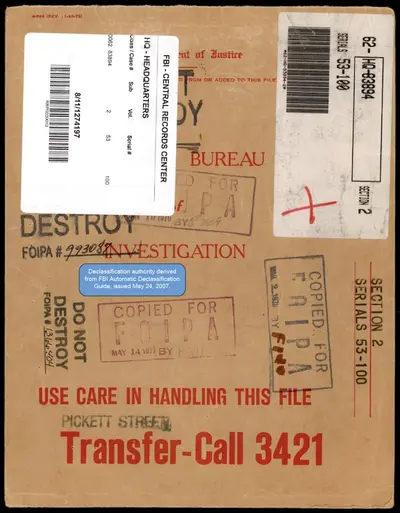
The documentation of this event was handled through the Federal Bureau of Investigation. At the time, the Bureau maintained standing protocols for the protection of vital installations, which required field offices in locations such as Knoxville, Albuquerque, and Los Angeles to route UFO reports to headquarters. This systematic approach ensured that sightings occurring in or near sensitive airspace were centralized for federal review.
The specific wording within the FBI file provides a direct account of the encounter, stating that the crew sighted and followed a flying saucer northwest of Bethel, Alaska. The file further confirms the altitude of one thousand feet and the rapid disappearance of the object. These records remained part of the internal government archives until their release under the PURSUE program.
Classification and Analysis
The Bethel sighting is classified as a pilot or aircrew sighting, a type of encounter where the observation occurs from the cockpit during active flight. Such cases are often considered highly significant by investigators due to the trained nature of the observers and the high-speed, high-altitude perspective provided by the aircraft.
The status of this case remains unresolved. Under the default designation of the All-domain Anomaly Resolution Office (AARO), all records released through the PURSBUE program are categorized as unresolved. The federal government has not issued a conclusion regarding whether the event was anomalous or conventional. Within the context of 1947, conventional explanations for such sightings often included experimental aircraft, weather balloons—specifically those associated with the Project Mogul series—or atmospheric optical phenomena like lenticular clouds and sundogs. Other possibilities included astronomical objects such as the Moon, Venus, or meteors appearing near the horizon.